
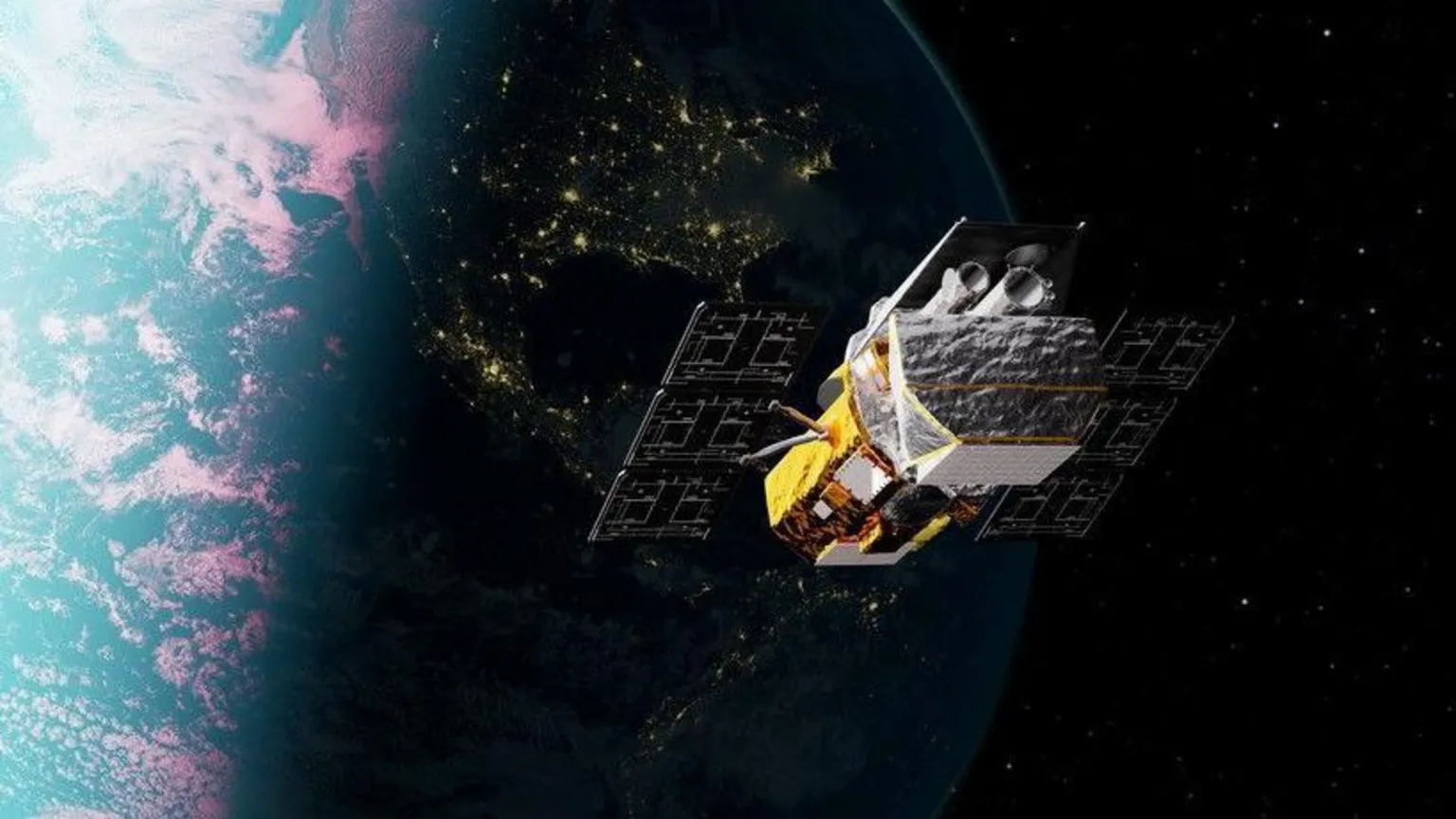
NASA has launched a pioneering mission to rescue its ageing Swift space telescope before it falls back to Earth.
The ambitious operation involves a robotic spacecraft designed to capture the observatory and raise it into a higher orbit, extending its mission to study some of the universe’s most powerful cosmic explosions.
The Swift observatory has been slowly losing altitude because increased solar activity has expanded Earth’s atmosphere, creating drag that has gradually pulled the spacecraft closer to the planet.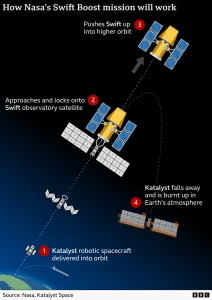
Launched in 2004, Swift originally orbited Earth at about 600 kilometres. Its altitude has now dropped to around 360 kilometres, with most of the decline occurring over the past two years.
Scientists warn that if the telescope falls below 300 kilometres, a rescue would no longer be possible.
The rescue mission is being carried out by LINK, a robotic spacecraft developed by Arizona-based Katalyst Space Technologies under a NASA-funded programme.
About the size of a refrigerator, LINK is equipped with three robotic arms, cameras, sensors and precision thrusters.
Over the coming weeks, the spacecraft will activate its onboard systems before carefully approaching the Swift telescope.
Once alongside the observatory, LINK will inspect it from multiple angles before attempting to grab it with its robotic arms.
If successful, the spacecraft will slowly raise Swift back to a stable orbit using its thrusters.
Space scientists say the operation is one of the most challenging satellite servicing missions ever attempted.
Dr Simeon Barber, a senior research fellow at the Open University, described the mission as high-risk but worthwhile because of Swift’s scientific importance.
He noted that the telescope provides unique observations of gamma-ray bursts and other high-energy cosmic events that cannot easily be studied by other spacecraft.
Swift was launched to detect gamma-ray bursts, the most energetic explosions in the universe.
These bursts are produced during the deaths of massive stars or the collision of ultra-dense stellar remnants, releasing enormous amounts of energy within seconds.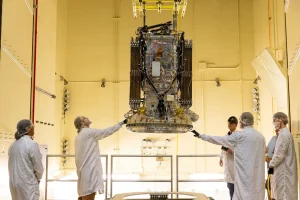
Its ability to quickly reposition itself to observe these short-lived events has made Swift one of the world’s most valuable space observatories.
Engineers at Katalyst Space Technologies developed the LINK spacecraft in less than a year to meet the shrinking rescue window.
Company Chief Executive Ghonhee Lee described the achievement as extraordinary, saying the team designed, built and tested the spacecraft in just eight months.
The rescue mission is expected to take several months, with LINK gradually lifting Swift back toward its original operating altitude.
If the mission succeeds, it could pave the way for future satellite servicing operations, including the possibility of extending the life of other ageing observatories such as the Hubble Space Telescope.
