
Ghana’s economy recorded strong growth in the first quarter of 2026, supported by rapid expansion in the technology sector and a rebound in industrial activity.
According to provisional data released by the Ghana Statistical Service (GSS), real Gross Domestic Product (GDP) grew by 6.4% between January and March 2026.
The figure represents an increase from the revised 6.2% growth recorded during the same period in 2025 and a significant improvement from the 4.9% growth posted in the first quarter of 2024.
Presenting the latest GDP estimates, Government Statistician Dr. Alhassan Iddrisu said the economy benefited from sustained growth and declining inflationary pressures.
One of the report’s key highlights was a sharp decline in the GDP deflator, which measures price changes across goods and services produced in the economy.
The GDP deflator fell to 4.1% in the first quarter of 2026, compared with 23.9% during the same period last year.
In nominal terms, Ghana’s economy was valued at GH¢420.4 billion in the first quarter of 2026.
This represents an increase from GH¢378.0 billion recorded a year earlier.
Real GDP at constant prices stood at GH¢57.4 billion during the period.
The non-oil economy also remained strong, recording growth of 6.3%.
Nominal non-oil GDP reached GH¢410.9 billion, highlighting the broad-based nature of the country’s economic expansion.
The services sector remained the largest contributor to economic activity.
The sector expanded by 7.1% and accounted for 48.3% of total GDP growth.
Growth was driven mainly by the Information and Communication Technology (ICT) sub-sector, which recorded an impressive 25.2% expansion.
This made ICT the fastest-growing sector in the economy during the quarter.
Transport and storage grew by 13.0%, while wholesale and retail trade expanded by 9.0%.
However, accommodation and food services contracted by 13.6%.
The industrial sector grew by 6.9%, up from 4.1% in the first quarter of 2025.
Mining and quarrying played a major role in the recovery, recording growth of 10.7%.
The oil and gas sector also returned to growth, expanding by 7.0% after contracting by 25.8% during the same period last year.
Manufacturing and electricity both recorded steady growth of 6.2%.
The agricultural sector expanded by 4.0% during the first quarter.
Although this was lower than the 6.6% growth recorded a year earlier, some subsectors performed strongly.
Forestry and logging rebounded sharply, recording growth of 9.0%.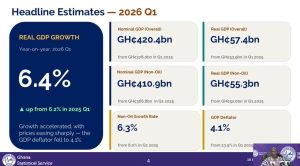
The latest figures suggest that Ghana’s economic recovery remains on track.
Growth across the technology, mining and industrial sectors, coupled with easing inflation, has strengthened confidence in the country’s economic outlook.
The data also indicate that growth is becoming more diversified, reducing reliance on the oil sector.
With improving macroeconomic conditions and continued investment in key sectors, analysts expect Ghana’s economy to maintain positive momentum throughout the remainder of 2026.
