
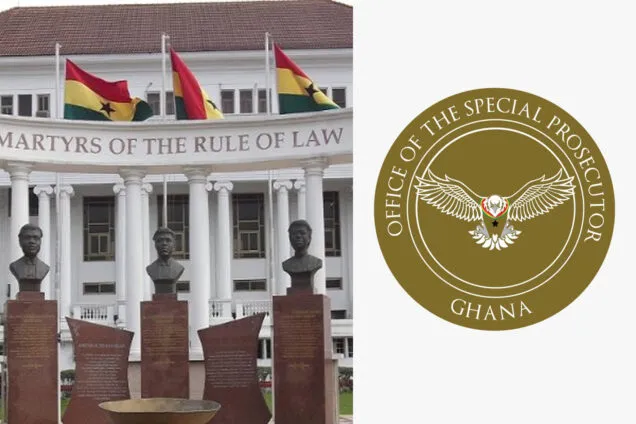
The Supreme Court has unanimously ruled that the Office of the Special Prosecutor (OSP) has the constitutional authority to investigate and prosecute corruption-related offences independently, while affirming that the Attorney-General (AG) retains the power to discontinue such prosecutions by entering a nolle prosequi.
The landmark judgment settles a long-running constitutional dispute over the prosecutorial powers of the OSP and clarifies the relationship between the anti-corruption agency and the Attorney-General’s office.
A seven-member panel of the apex court, chaired by Chief Justice Paul Baffoe-Bonnie, dismissed a suit filed by private legal practitioner Noah Adamtey, who challenged the constitutionality of Sections 3(3) and 4 of the Office of the Special Prosecutor Act, 2017 (Act 959).
Mr. Adamtey argued that Article 88 of the 1992 Constitution grants the Attorney-General exclusive authority to prosecute criminal offences. He contended that Parliament exceeded its constitutional mandate by enacting provisions that give the OSP independent prosecutorial powers and asked the court to declare those sections unconstitutional.
The Supreme Court rejected the challenge, holding that Parliament acted within its constitutional powers in establishing the Office of the Special Prosecutor with the authority to investigate and prosecute corruption and corruption-related offences without prior approval from the Attorney-General.
While affirming the OSP’s prosecutorial independence, the court also clarified that the Attorney-General retains the constitutional authority to intervene in criminal proceedings through a nolle prosequi, a legal mechanism used to formally discontinue a prosecution.
The ruling means the OSP can initiate and conduct criminal prosecutions independently, but the Attorney-General retains the final constitutional power to terminate those proceedings where necessary.
The decision also rejected the position advanced by the Attorney-General’s office during the proceedings.
Deputy Attorney-General Justice Srem-Sai had argued that prosecutorial authority under the Constitution belongs exclusively to the Attorney-General and that any authority exercised by the Office of the Special Prosecutor is derived from the Attorney-General’s constitutional mandate.
However, the Supreme Court unanimously dismissed the suit, effectively affirming that the Office of the Special Prosecutor Act is consistent with the Constitution and that the OSP’s independent prosecutorial powers are lawful.
The ruling is expected to strengthen the legal foundation of the Office of the Special Prosecutor, which was established to lead Ghana’s anti-corruption efforts and has investigated and prosecuted several high-profile corruption-related cases.
At the same time, the judgment reinforces the Attorney-General’s constitutional oversight of criminal prosecutions by confirming the power to discontinue cases initiated by the Special Prosecutor through a nolle prosequi.
