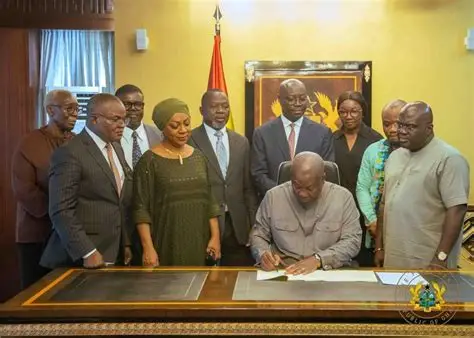
John Dramani Mahama has signed the Value for Money Office Bill into law, in a move aimed at strengthening accountability in public spending and reducing inflated government contract costs.
The legislation is expected to introduce stricter oversight of public procurement processes, particularly single-source contracts, which have long attracted concerns over transparency and value for money.
Announcing the development after the signing ceremony on Monday, Cassiel Ato Forson, Ghana’s Finance Minister, described the law as a major milestone in the government’s efforts to control rising public expenditure linked to overinflated contracts.
According to Dr Forson, all future single-source procurement arrangements will be required to undergo assessment by the newly established Value for Money Office to ensure that government secures fair value for public funds spent.
He explained that responsibility for conducting such assessments had previously rested with the Legal Division of the Ministry of Finance, which he said lacked the specialised technical expertise needed for comprehensive value-for-money evaluations.
The new law therefore seeks to institutionalise the process through a dedicated office equipped with the technical capacity to independently review and assess public sector contracts.
The establishment of the office forms part of President Mahama’s broader governance and public financial management reform agenda, and fulfils one of his campaign commitments focused on improving transparency and efficiency in government expenditure.
Dr Forson disclosed that government is already taking steps to operationalise the office, including allocating resources, appointing leadership, and assembling a technical team to oversee implementation.
He indicated that the office is expected to become fully operational by January 2027.
According to the Finance Minister, the new framework is intended to significantly reduce the incidence of inflated public contracts and improve oversight within Ghana’s procurement system.
The law is also expected to strengthen public confidence in government spending by introducing more rigorous scrutiny and accountability mechanisms for state-funded projects and procurement arrangements.
