
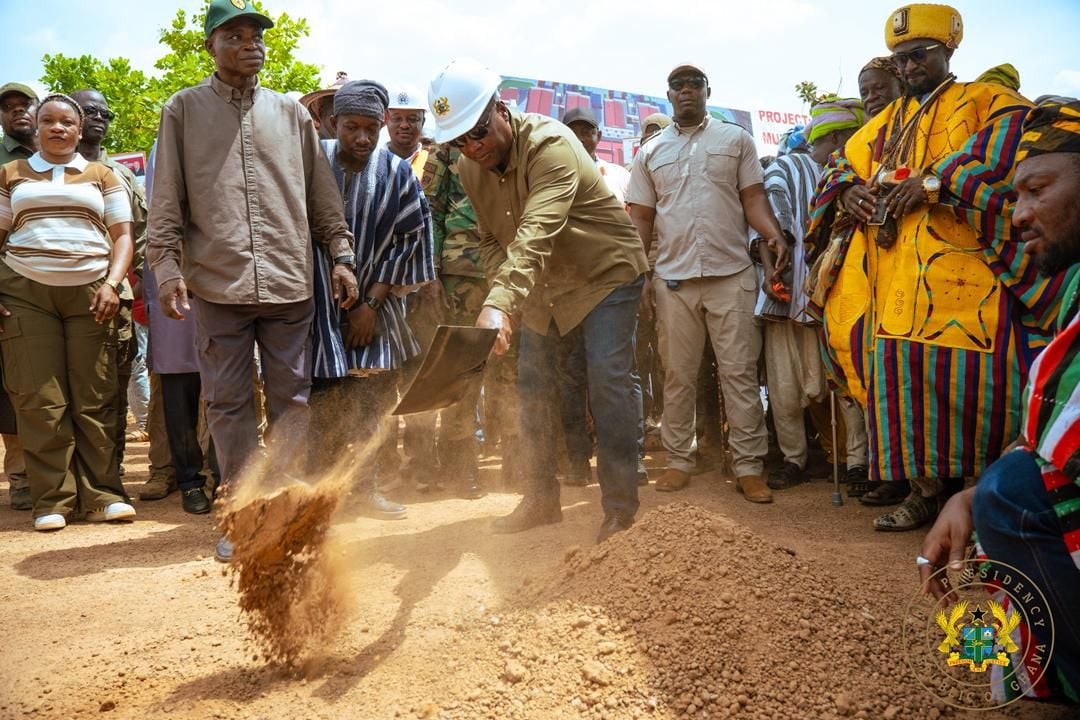
John Dramani Mahama has stated that the government’s plan to construct modern multipurpose markets nationwide is a key strategy to stimulate economic growth and create wealth within local communities.
According to him, the proposed 24-hour market model represents a shift from traditional trading systems. The new markets will incorporate essential services such as banking facilities, storage units, fire and security systems, as well as restaurants, crèches, and clinics to support traders’ welfare.
Speaking at a sod-cutting ceremony for a new 24-hour market project in Bimbilla, the President reaffirmed that all 261 districts across Ghana will benefit from the initiative. He emphasized that the goal is to transform periodic market activity into a continuous economic cycle.
Mahama explained that traditional markets typically operate only once or twice a week, limiting business opportunities. By enabling round-the-clock trading, the government aims to boost commerce and attract more participants from across the country.
He also underscored the critical link between agriculture and market access, noting that farmers cannot thrive without reliable outlets to sell their produce. Describing Bimbilla as a key agricultural hub, he said the area deserves a large-scale facility to support its role as a major food-producing region.
The President further revealed that the Council for Scientific and Industrial Research (CSIR) will introduce value addition technologies to extend the shelf life of crops, reduce post-harvest losses, and help farmers and traders maximize returns.
Meanwhile, Ahmed Ibrahim, Minister for Local Government, Chieftaincy and Religious Affairs, cautioned contractors against substandard work, warning that poorly executed or delayed projects would be reassigned.
As part of his tour of the Northern Region, Mahama accompanied by Haruna Iddrisu and other officials also inspected ongoing construction of a 300-capacity, three-storey hostel at the Bimbilla EP College of Education.
The 24-hour market initiative forms part of the government’s broader agenda to modernize infrastructure, enhance trade, and drive sustainable national development.
