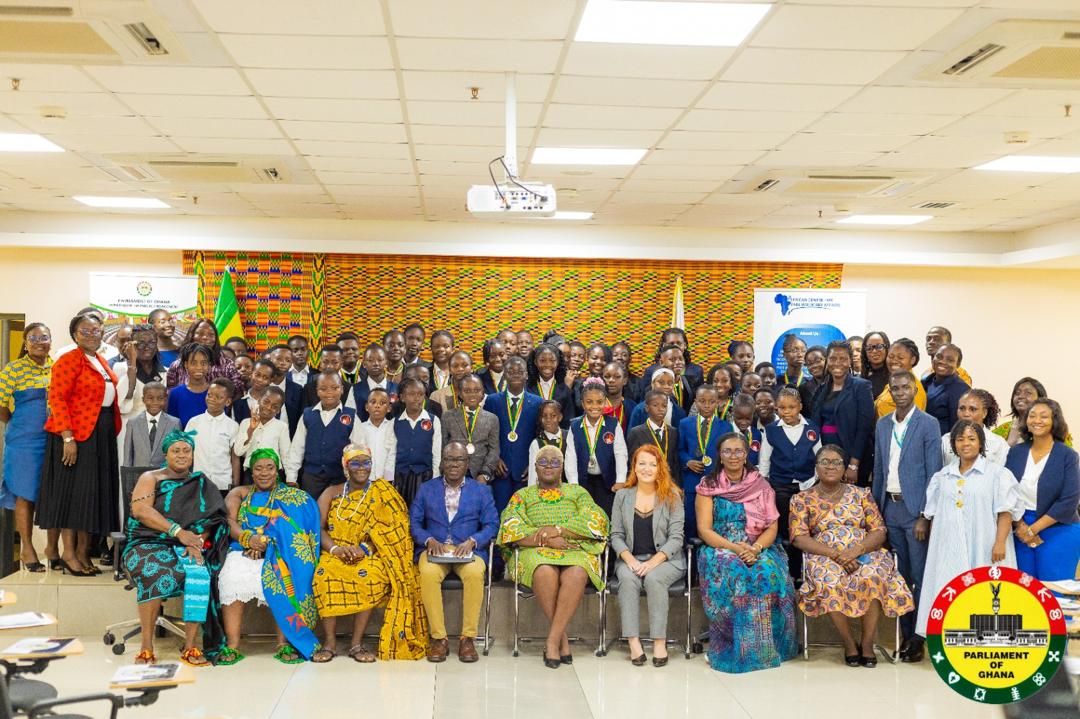
The Parliament of Ghana has launched a Mini Parliament initiative aimed at amplifying children’s voices and strengthening their participation in national decision-making processes.
The initiative, developed in partnership with the African Centre for Parliamentary Affairs (ACEPA), UNICEF, and the Learning Tree Foundation, seeks to provide young people with a practical platform to engage in governance and civic dialogue.
Speaking at the launch, the Chairperson of the Parliamentary Committee on Gender, Children and Social Protection and MP for Krachi West, Helen Ntosu, said there is a growing need for stronger engagement mechanisms that allow children and young people to express their views on national issues.
She noted that modern governance requires inclusive participation, adding that citizens—especially the youth—are increasingly demanding platforms to contribute to policy discussions.
At the event, UNICEF’s Chief Social Policy and Inclusion Officer, Paulina Sarvilahati, emphasized that children must be heard, protected, and empowered, stressing that child participation is a key principle of the UN Convention on the Rights of the Child.
She reminded participants of Ghana’s historic role as the first country to ratify the Convention and encouraged children to be confident in expressing their views on issues that affect them.
The Divisional Public Affairs Officer of Parliament, Kate Addo, praised the children for their confidence and engagement, urging them to remain disciplined, informed, and committed to their education as future leaders.
The Director of Public Engagement at Parliament, Supt (Rtd) Effia Tenge, explained that the initiative was introduced after observing that many of the over 44,000 visitors—mostly students—who toured Parliament between 2023 and 2025 struggled to fully understand parliamentary procedures.
She said the Mini Parliament will offer a hands-on learning experience where children assume parliamentary roles and debate national issues affecting young people.
The Executive Director of ACEPA, Rasheed Draman, also welcomed the initiative, noting that early exposure to governance structures helps build responsible and informed citizens.
During the maiden sitting, participants debated “Responsible Use of Technology by Children,” focusing on online safety, digital responsibility, and the impact of technology on children’s wellbeing.
Officials from the Cyber Security Authority (Ghana) educated the children on internet safety, cyberbullying, and protecting personal data online.
Commending the initiative, the Queen Mother of the Dzorwulu Abelemkpe Subdivision Stool, Manye Naa Badu Diaba I, encouraged the children to uphold strong moral values, listen to guidance from parents and teachers, and strive to become responsible future leaders.
