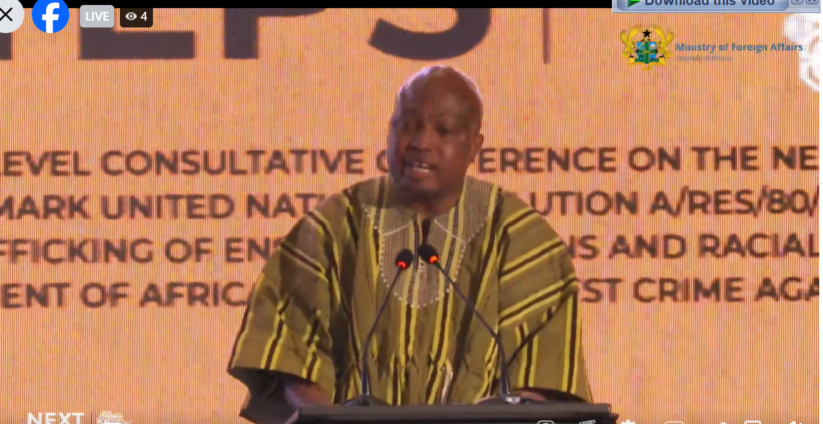
Foreign Affairs Minister Samuel Okudzeto Ablakwa says growing international support for reparatory justice is vindicating Ghana’s efforts at the United Nations, insisting that critics who once dismissed the initiative as an academic exercise are now being forced to rethink their position.
Speaking at a gathering of heads of state, foreign ministers, scholars and members of the African diaspora, Mr Ablakwa said the global conversation on reparations for the trans-Atlantic slave trade has evolved into a serious policy issue that demands practical action.
According to him, the United Nations resolution declaring the trans-Atlantic slave trade and the enslavement of Africans as the gravest crime against humanity has helped elevate the issue onto the global agenda.
“The reports for these conversations demonstrate that reparatory justice is no longer a peripheral issue. It is now firmly established as a legitimate global concern that demands serious engagement and thoughtful solutions,” he said.
Mr Ablakwa noted that developments since the adoption of the resolution show that many who previously questioned its relevance are now reassessing their views.
“Those who thought it was merely an academic exercise are now revising their notes,” he stated.
Growing Global Acknowledgement
The Foreign Affairs Minister pointed to a number of recent apologies and acknowledgements by international institutions and leaders as evidence that momentum for reparatory justice is growing.
He cited an apology by Pope Leo XIV for the historical role of the Catholic Church and papal decrees that were used to justify slavery.
“We have all heard the apology from Pope Leo XIV, the head of the Catholic fraternity, apologising for the role of the Catholic Church and the papal bulls that offered theological doctrinal justification for slavery,” Mr Ablakwa said.
He added that Ghana and its international coalition, led by John Dramani Mahama, had welcomed the apology as part of broader reconciliation efforts.
“We have warmly accepted the apology,” he said.
Mr Ablakwa also referenced an apology from the leadership of the Church of Scotland for its historical links to slavery.
Colonial Legacy Under Scrutiny
The minister further highlighted comments by Emmanuel Macron, who has called for France to confront aspects of its colonial history and is expected to address the conference in Accra.
According to Mr Ablakwa, France has taken steps to address its past, including efforts to move away from legal frameworks associated with slavery.
“He has also led France to take steps to confront its colonial past, including moves to repeal the Code Noir—that deeply dehumanising set of laws which treated Africans as commodities,” he said.
Reparations Debate Moves Beyond Academia
Mr Ablakwa concluded that recent developments demonstrate that reparatory justice has become a major international issue rather than a purely academic discussion.
He said growing recognition of historical injustices, coupled with public apologies and policy engagement by global institutions, shows that the conversation around reparations is increasingly shaping international discourse and diplomatic relations.
According to him, the focus must now shift from acknowledgement to meaningful action aimed at addressing the enduring consequences of slavery and colonialism.
