
New Discoveries Reshape Our Understanding of the Universe’s Matter
Scientists in 2026 are making strides in understanding some of the universe’s most perplexing components — from the elusive dark matter that shapes cosmic structure to the faint signals from the universe’s earliest “dark ages.” These advances are reshaping how researchers think about the matter of the universe and its origins.
Rethinking Dark Matter: Hot Instead of Cold?
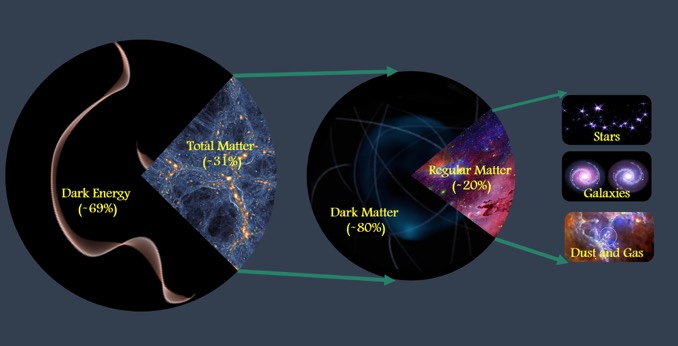
For decades, cosmologists have worked under the assumption that dark matter — the invisible substance making up about 85 % of the universe’s total matter — was “cold,” meaning its particles moved slowly compared to the speed of light. However, recent research now suggests that dark matter could have originated as extremely hot particles shortly after the Big Bang and still cooled in time to allow galaxies to form. If correct, this would significantly revise existing cosmological models.
This hot dark matter hypothesis opens new possibilities for what dark matter might be and how it behaved in the universe’s infancy — marking a potential shift from the long-standing Lambda-CDM model that has dominated cosmology.
Echoes from the Universe’s Dark Ages
Astronomers are also homing in on signals from the cosmic dark ages — the period after the Big Bang but before the first stars shone. Faint radio signatures from this era could hold clues about how early matter clumped and how dark matter influenced the birth of structure in the cosmos.
These faint imprints, once nearly impossible to detect, are now within reach thanks to cutting-edge observatories and analysis techniques, offering a direct window into matter’s distribution in the early universe.
Interactions Between Dark Matter and Neutrinos
Another exciting development is evidence suggesting interactions between dark matter and neutrinos — ghost-like particles that rarely interact with ordinary matter. If confirmed, this could challenge aspects of the standard model of cosmology and help explain why matter in the universe appears less “clumpy” than models predict.
This finding holds promise for solving persistent puzzles about large-scale cosmic structure and the fundamental nature of matter.
New Cosmic Structures: ‘Cloud-9’ and Ancient Supernovas
Observations by the Hubble Space Telescope recently revealed a starless, gas-rich object nicknamed “Cloud-9” — believed to be dominated by dark matter and a remnant of early galaxy formation. This discovery offers a rare glimpse into matter that never formed stars but still influences the cosmos through gravity.
At the same time, the James Webb Space Telescope (JWST) captured one of the earliest known supernovas, illuminating the distribution of heavy elements in the young universe and providing insight into how matter evolved over time.
What All This Means for Our Picture of the Universe
Taken together, these breakthroughs point to a more complex and dynamic universe than previously imagined. They suggest that:
-
The nature and origin of dark matter may differ from long-held models.
-
Fossil light from the cosmos’s infancy can now be used to map matter’s early behavior.
-
Interactions between unseen particles like neutrinos and dark matter could unlock deeper physics.
-
Newly observed cosmic objects and ancient stellar explosions offer fresh clues about matter’s evolution.
As scientists refine their tools and push observational boundaries, our understanding of the matter that makes up the universe continues to evolve — blending cosmology, particle physics, and astronomy in increasingly profound ways.
