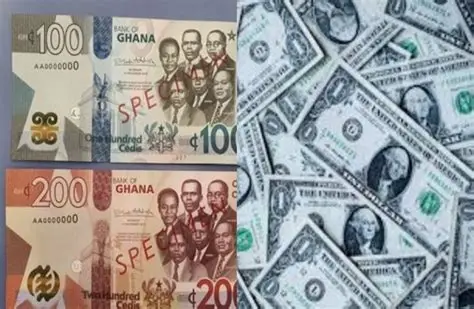
The Bank of Ghana expects the relative stability of the cedi to continue, with no return to the sharp appreciation recorded in 2025, according to the Head of its Financial Markets Department, Gershon Kudjo Agbledzorwu.
Speaking on The Key Points on Saturday, May 2, he described the currency’s 41% appreciation in 2025 as a “correction” of earlier distortions rather than a trend likely to be sustained.
“What we saw in 2025… is a kind of correction,” he said, adding that both IMF assessments and independent studies suggest the cedi is not overvalued.
“Going forward, we expect the currency to be stable. Once our currency is stable, we don’t expect the sharp appreciation we have seen, and therefore the issues from the significant revaluation losses may not arise.”
His comments come amid scrutiny of the central bank’s Domestic Gold Purchase Programme, which recorded a loss of GH¢9.05 billion in 2025, up from GH¢5.66 billion in 2024.
Head of Gold Management at the BoG, Paul Bleboo, defended the programme, arguing that the losses were the cost of achieving macroeconomic stability.
“The net cost to the bank… is GH¢9.1 billion. We are all witnesses to the economic stability we are enjoying… Definitely, there is a cost to it,” he said on the same programme.
Bleboo explained that the initiative was introduced in response to economic shocks from the COVID-19 pandemic and the Russia-Ukraine war, which severely impacted the cedi. The central bank leveraged gold purchases using local currency, exported and refined the gold, and added it to reserves to stabilise the economy.
According to the BoG’s 2025 Financial Report, the programme recorded a gross loss of GH¢21 billion, with a net cost of GH¢9.1 billion to the central bank.
During the year, 2.91 million fine ounces of doré gold were purchased, while 2.89 million ounces were sold. The remaining holdings stood at 9,283 ounces by the end of December 2025.
The report noted that gold acquired under the Gold for Reserves Programme was intended for foreign exchange generation and not for price speculation. Losses reflected prevailing market prices at the time of sale relative to acquisition costs, alongside associated operational expenses.
Under the Gold for Oil Programme, gold trading resulted in a net loss of GH¢0.544 billion, although oil trading activities generated a net gain of GH¢0.341 billion. The programme was discontinued in March 2025.
Overall, the BoG said the financial outcomes reflect a combination of gold and oil trading margins as well as operational costs incurred in efforts to stabilise the currency and ensure energy supply.
