
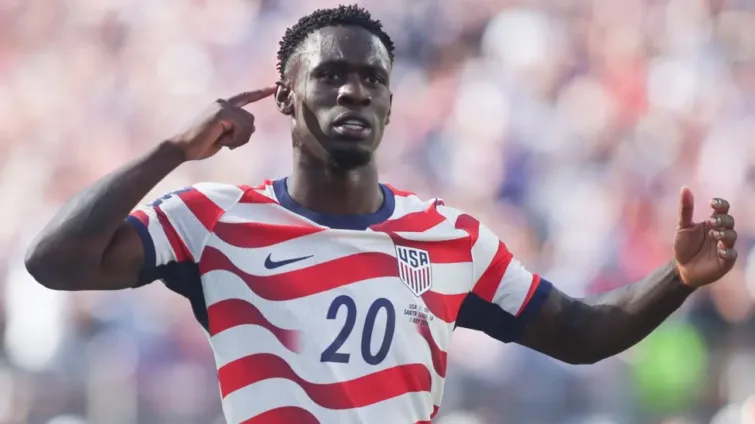
The chairman of FIFA’s disciplinary committee, Mohammad Al Kamali, has declined to answer questions from the BBC about the decision to waive a suspension for United States striker Folarin Balogun after he was sent off during the FIFA World Cup.
Balogun, 25, received a red card for serious foul play in the United States’ match against Bosnia-Herzegovina. Under FIFA’s disciplinary rules, the offence would ordinarily attract a two-match suspension.
However, FIFA’s disciplinary committee decided to waive the additional ban, a move that drew widespread criticism after reports emerged that United States President Donald Trump and White House officials had lobbied FIFA over the player’s sanction.
BBC questions go unanswered
BBC Sport editor Dan Roan approached Al Kamali before England’s World Cup quarter-final against Norway on Saturday and asked several questions about the committee’s decision.
Among the questions were whether FIFA President Gianni Infantino had asked the committee to suspend Balogun’s ban, why England defender Jarell Quansah received a two-match suspension for a similar offence, and whether Al Kamali wished to respond to the controversy surrounding the case.
Al Kamali declined to answer any of the questions.
Different outcome for Quansah
The controversy has intensified because England’s Jarell Quansah received a two-match suspension after being sent off for a high challenge on Mexico’s Jesús Gallardo during England’s 3-2 victory.
FIFA classified Quansah’s tackle as serious foul play and imposed an additional one-match suspension on top of the automatic one-game ban that follows a red card.
The differing outcomes have prompted questions about consistency in FIFA’s disciplinary decisions.
FIFA defends independence of disciplinary bodies
FIFA President Gianni Infantino has rejected suggestions that he influenced the committee’s decision.
“FIFA’s judicial bodies are independent. They operate autonomously… Their independence is essential to the credibility and integrity of football, and this must always be respected,” he said.
Following the controversy, FIFA issued an 871-word statement defending its decision to waive Balogun’s suspension.
The governing body said the disciplinary committee reached its decision after “considering all of the specific circumstances surrounding the incident and evidence available.”
However, FIFA did not disclose the specific evidence or circumstances that led the committee to depart from its usual disciplinary sanction, leaving questions over the decision unanswered.
