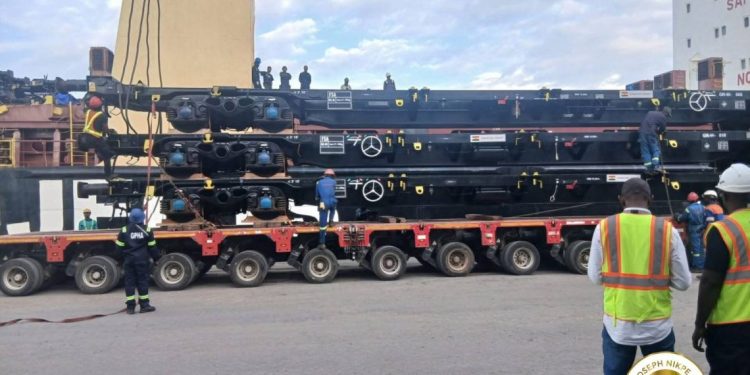
The Ministry of Transport has defended the government’s acquisition of two refurbished diesel locomotives and 20 freight wagons, insisting they are revenue-generating assets that will strengthen Ghana’s railway freight operations.
The Ministry was responding to criticism from the New Patriotic Party (NPP), which questioned the age, condition, cost and long-term value of the rolling stock.
Ministry Rejects ‘Museum Piece’ Claims
In a statement issued on Thursday, July 3, the Ministry dismissed suggestions that the imported Class 56 locomotives were obsolete and only fit for a museum.
It said the criticism reflected “a fundamental misunderstanding of railway engineering and locomotive operations.”
According to the Ministry, the locomotives underwent extensive refurbishment in the United Kingdom before being shipped to Ghana.
The work included complete overhauls of the diesel engines, electrical traction systems, traction motors, bogies and braking systems, along with the installation of modern railway safety equipment.
The Ministry said the locomotives were fully tested and certified for export and are backed by a five-year warranty against operational defects.
It added that, with routine maintenance, they are expected to remain in service for at least 15 years before requiring major overhauls.
“The rolling stock investment cost will be recovered within about two years while providing at least fifteen additional years of productive service. That is not waste. That is value for money. That is not propaganda. That is practical railway economics,” the statement said.
Spare Parts and Maintenance Assured
Addressing concerns about maintenance, the Ministry said Class 56 locomotives are still used in commercial freight operations in the United Kingdom and Hungary.
It noted that spare parts remain readily available and that the Ghana Railway Development Authority (GRDA) has secured agreements to supply five years’ worth of critical spare parts and consumables.
The Ministry also disclosed that specialist engineers have arrived in Ghana to train GRDA technicians and engineers through hands-on technology transfer programmes.
Freight Operations Backed by Equipment
The Ministry rejected claims that the Tema-Mpakadan railway lacks the equipment required for freight operations.
It said the GRDA already has two reach stackers and five heavy-duty forklifts capable of handling containers and bulk cargo.
The Authority is also procuring two gantry cranes to strengthen long-term cargo handling capacity.
“The claim that GRDA lacks lifting equipment is therefore factually inaccurate, technically uninformed and politically mischievous,” the Ministry stated.
Investment Expected to Generate Revenue
The Ministry said feasibility studies carried out before the construction of the Tema-Mpakadan railway identified strong freight demand along the corridor.
It disclosed that the GRDA is finalising commercial off-take agreements, with one expected to generate approximately US$3.5 million annually.
According to the Ministry, the government acquired the two freight locomotives and 20 container wagons for about GH¢37.6 million (US$3.18 million).
It contrasted that with the previous NPP administration’s purchase of two PESA diesel multiple-unit passenger trains for US$14.67 million (about GH¢164.7 million).
The Ministry argued that the comparison demonstrates a more cost-effective investment, noting that the new locomotives are designed specifically for freight operations that will generate revenue.
“These are not decorative assets. They are revenue-generating freight assets designed to move containers and industrial cargo between Tema Port and Mpakadan, reduce the cost of logistics, ease pressure on Ghana’s roads, support industrialisation and generate sustainable railway income,” the statement said.
Ministry Highlights Railway Improvements
The Ministry further accused the previous administration of leaving major railway infrastructure in poor condition, including the Kojokrom-Sekondi line, unresolved defects on the Tema-Mpakadan railway and abandoned works on the Western Railway Line.
It said the current administration has restored passenger rail services between Kojokrom, Sekondi and Takoradi, recommissioned diesel multiple-unit trains, rehabilitated rail infrastructure and resumed stalled construction on the Western Railway Line.
The Ministry added that signalling defects inherited on the Tema-Mpakadan railway are also being addressed with approximately US$21 million in European Union grant support.
