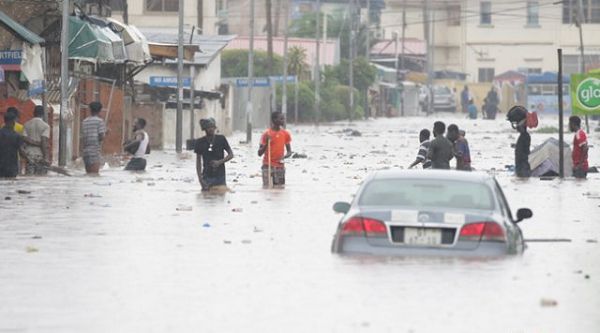
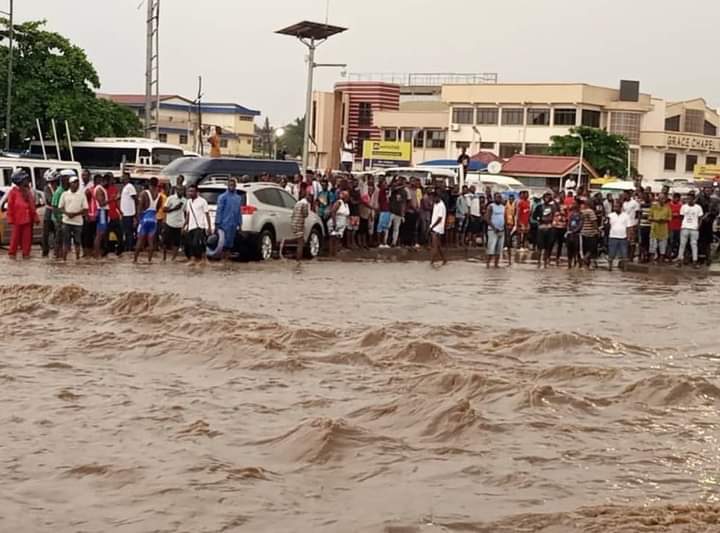
The Ghana Meteorological Agency (GMet) has warned that Accra faces an elevated risk of flooding this June, with rainfall totals across the Coastal Zone expected to range between 100 and 150 millimetres.
According to the agency, the capital has become increasingly vulnerable to flooding over the years, to the extent that rainfall amounts as low as 30 millimetres can now inundate some communities.
The Deputy Director and Head of Research and Applied Meteorology at GMet, Francisca Martey, said human activities and rapid urban development had significantly reduced the city’s natural ability to absorb and drain rainwater, making floods more frequent and severe.
She explained that flooding in Accra is not solely the result of rainfall within the city itself but is also influenced by runoff from surrounding communities located on higher elevations.
“When it rains, water from surrounding areas such as Berekusu and other communities eventually drains into Accra, increasing the volume of water the city must handle,” she said.
Mrs Martey noted that many natural flood retention areas that once stored excess rainwater have been overtaken by residential and commercial developments.
“These areas were naturally designed to collect rainwater, but many have now been built over, reducing their ability to serve that purpose,” she said.
She warned that the situation could become more challenging this month given the projected rainfall levels.
Mrs Martey said rapid urbanisation has concentrated stormwater into narrow drainage systems that are often unable to cope with heavy rainfall.
In the past, rainwater spread across wider surfaces and gradually infiltrated the soil. Today, much of that water is channelled into gutters and drains that can easily become overwhelmed during intense rainfall events.
“Once the volume of water exceeds the capacity of the drainage systems, it spills over and floods surrounding communities,” she explained.
She cited Bel Aqua in Tema as an example of development occurring on a natural watercourse, a factor she believes contributes significantly to persistent flooding in the area.
According to her, addressing the flooding challenge requires coordinated action from city authorities, planners and engineers.
While GMet provides weather forecasts and early warnings, she stressed that implementing long-term solutions falls within the mandate of urban planning and local government institutions.
“The city authorities, planners and engineers understand the interventions required. Our responsibility is to provide the forecasts and warnings needed to support decision-making,” she said.
The warning forms part of GMet’s June 2026 Rainfall Outlook, which forecasts predominantly wet conditions across much of the country, particularly in the Forest and Coastal zones.
In the Savannah Zone, including Navrongo, Zuarungu, Tamale, Walewale, Bole and Yendi, rainfall is expected to remain near normal. However, stronger chances of normal to above-normal rainfall are forecast for Wa and Bolgatanga, where cumulative rainfall totals are projected to range between 150 and 210 millimetres.
The Transition Zone is expected to experience mixed rainfall patterns. Areas such as Kintampo, Wenchi, Atebubu, Mim, Salaga and Kete Krachi are likely to record normal to above-normal rainfall, with totals estimated between 200 and 250 millimetres.
Conversely, Bui, Sunyani, Dormaa and Ejura are expected to experience normal to below-normal rainfall conditions.
In the Forest Zone, communities including Dunkwa, Kumasi and Akim Oda are forecast to receive enhanced rainfall activity, with cumulative totals ranging between 200 and 400 millimetres. Akuse and nearby areas are expected to record comparatively lower rainfall amounts.
Across the Coastal Zone, predominantly normal to above-normal rainfall conditions are expected, with cumulative rainfall projected between 100 and 150 millimetres.
Mrs Martey urged disaster management agencies to strengthen emergency preparedness and response measures in anticipation of possible localised flooding.
Although the expected rainfall is likely to support agricultural activities and improve water availability, she stressed the need for authorities and community leaders to remain vigilant and implement measures that reduce flood-related risks.
She said proactive planning, improved drainage management and greater public awareness would be critical in minimising the impact of flooding during the rainy season.