
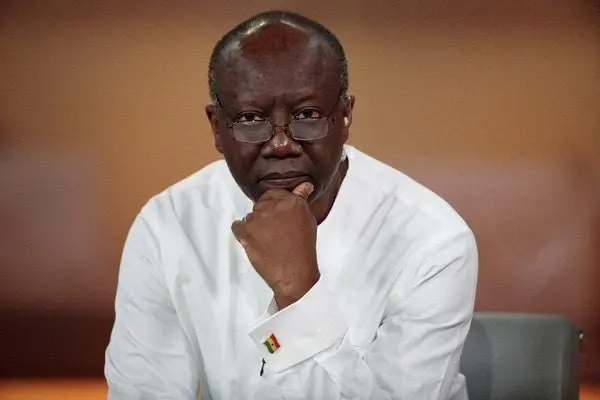
Government Spokesperson and Minister of Government Communications, Felix Kwakye Ofosu, has disclosed that the Attorney-General will hold discussions with officials of the United States Department of Justice on pending extradition requests involving Ghana and the United States.
According to Kwakye Ofosu, the engagement aims to strengthen cooperation between the two countries and address outstanding cases that require legal assistance and extradition arrangements.
He made the disclosure following the return of former Microfinance and Small Loans Centre (MASLOC) Chief Executive Officer, Sedina Tamakloe-Attionu, to Ghana after a successful extradition process.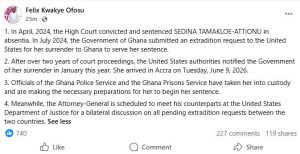
Tamakloe-Attionu arrived in Accra on Tuesday, June 9, 2026, after US authorities approved Ghana’s request for her extradition.
Officials of the Ghana Police Service and the Ghana Prisons Service have since taken her into custody and are making arrangements for her to begin serving her prison sentence.
Her return follows a lengthy legal process that began after an Accra High Court convicted and sentenced her in absentia in April 2024.
The Government of Ghana submitted an extradition request to the United States in July 2024, seeking her return to serve her sentence. In January 2026, US authorities informed Ghana that the request had been approved.
In 2024, the High Court sentenced Tamakloe-Attionu to 10 years’ imprisonment with hard labour after finding her guilty of causing financial loss to the state.
The court also convicted her on charges including stealing and money laundering. Businessman Daniel Axim was convicted alongside her.
The case centred on allegations that public funds intended to support small businesses and entrepreneurs through MASLOC were misapplied during her tenure as Chief Executive Officer.
Prosecutors accused her of causing financial loss to the state, stealing, conspiracy and the misuse of public funds.
In 2021, the High Court granted Tamakloe-Attionu permission to travel to the United States for medical treatment while her trial was ongoing.
However, she failed to return to Ghana to continue participating in the proceedings. As a result, the court continued the trial in her absence and later convicted her in absentia.
Her extradition and return to Ghana are being viewed as one of the country’s most significant recent extradition successes.
The case also highlights ongoing efforts by Ghanaian authorities to ensure that individuals facing criminal proceedings or convictions cannot evade justice by remaining outside the country.
The upcoming discussions between the Attorney-General and the US Department of Justice are expected to build on this cooperation and address other pending extradition matters involving both countries.
