
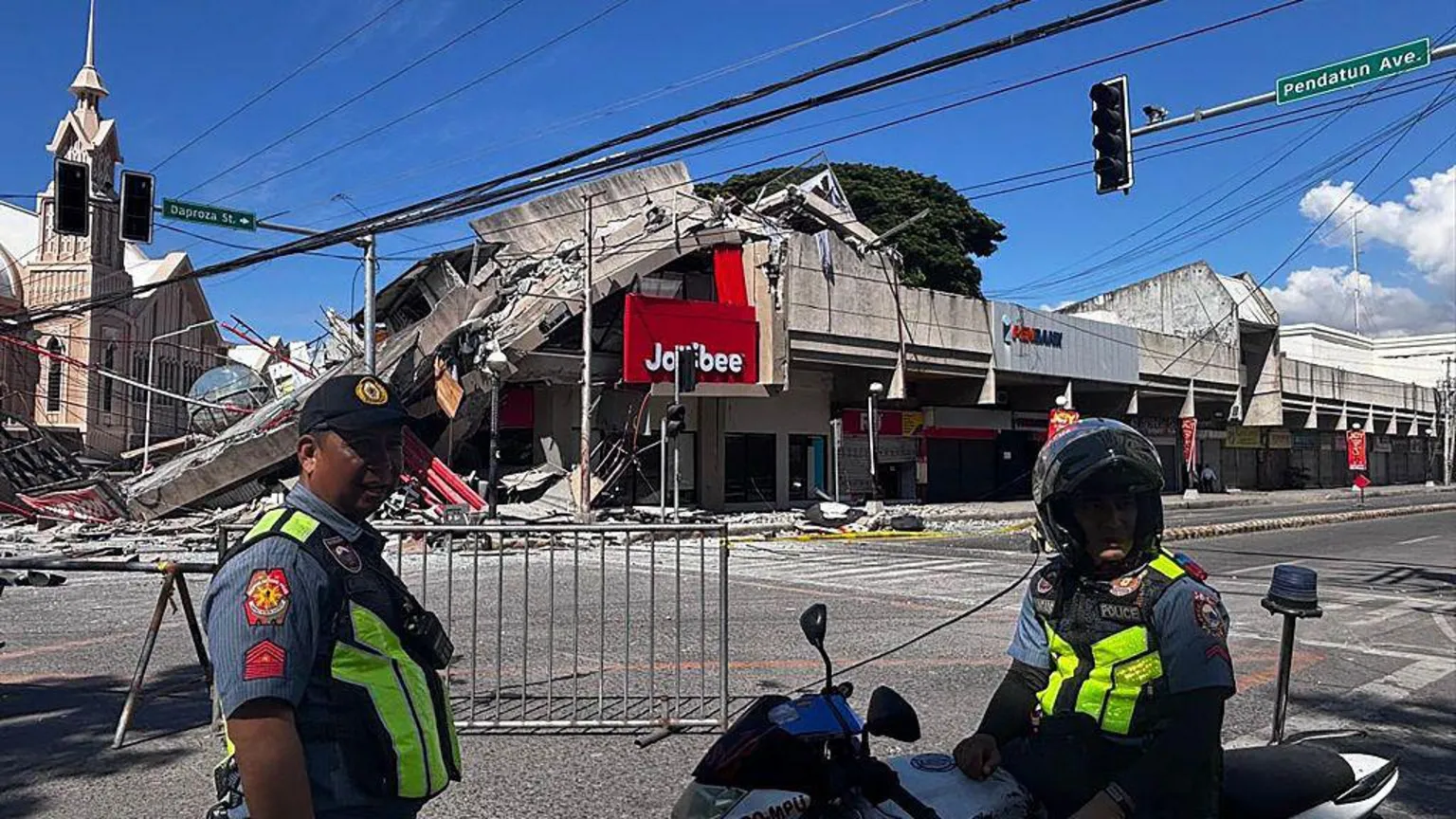
At least 19 people have died after a powerful earthquake struck off the coast of Mindanao in the southern Philippines.
The 7.8-magnitude quake hit on Monday morning at 7:37 a.m. local time. Authorities also recorded more than 130 injuries across several affected areas.
The earthquake triggered tsunami alerts in the Philippines, Japan, Indonesia and Australia. Officials later cancelled some of the warnings after assessing the situation.
Videos shared on social media showed extensive damage in several communities.
One widely circulated clip showed a Jollibee fast-food restaurant collapsing into rubble after the quake.
Authorities reported injuries in South Cotabato, Sultan Kudarat, Sarangani and General Santos City. Officials are still verifying the casualty figures.
The National Disaster Risk Reduction and Management Council is expected to release a final assessment after collecting reports from local authorities and emergency agencies.
President Ferdinand Marcos Jr said government agencies were working together to support affected communities.
“The national government is moving and we will not leave Mindanao behind,” he said.
The president also suspended classes in affected areas. The earthquake struck on the first day of the new school year.
In Davao Occidental, a video from a primary school showed frightened students crouching on shaking ground during the tremor.
The footage also captured a shelter collapsing nearby. School officials later confirmed that no students were injured.
Seismologists recorded more than 130 aftershocks following the main earthquake.
The aftershocks ranged in magnitude from 1.3 to 6.7.
In Sarangani Province, the quake temporarily disrupted electricity and communication services. Authorities later restored both networks.
General Santos City, located near the epicentre, is known as the country’s tuna capital and the hometown of former boxing champion Manny Pacquiao.
The earthquake prompted tsunami warnings across parts of the Pacific.
Japanese authorities initially warned that waves of up to one metre could reach coastal areas.
Later, officials reported smaller waves in Okinawa and the Ogasawara Islands.
Authorities also detected tsunami waves along parts of the Philippines, Indonesia and Palau. Wave heights ranged from a few centimetres to about 1.4 metres.
The Philippines lies along the Pacific Ring of Fire, one of the world’s most active seismic zones.
As a result, earthquakes occur frequently across the country.
While many tremors cause little damage, some have proved deadly. Last September, a 6.9-magnitude earthquake struck the Visayas region, killing more than 70 people.
Rescue teams continue to assess the damage and support affected communities as authorities monitor aftershocks and possible further risks.
