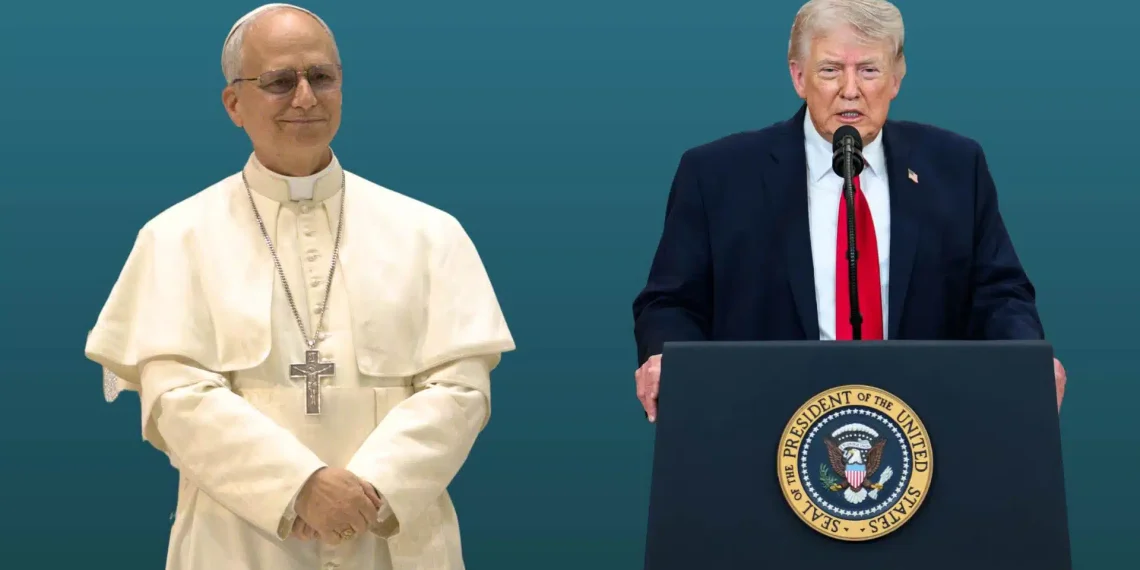
It is not unusual for US President Donald Trump to face criticism from Catholic leaders, particularly over his hardline immigration policies, which have long drawn condemnation from sections of the Church hierarchy.
However, a more unusual and broader wave of criticism has emerged in recent days, following Trump’s public attack on Pope Leo and his sharing of an AI-generated image depicting himself in a Christ-like form.
For months, tensions have existed between the Catholic hierarchy in the United States and more right-leaning lay Catholics who have generally supported Trump. But the latest backlash particularly over the Iran war and Trump’s remarks about the Pope has exposed deeper fractures within conservative Catholic circles.
What stands out is that some of the strongest criticism is now coming from loyal, conservative Catholic allies who have previously supported the president.
They are not only reacting to Trump’s rhetoric toward Pope Leo, whom he described as overly liberal and “weak on crime,” but also expressing concern over the moral justification of the ongoing Iran conflict, which began six weeks ago.
Bishop Joseph Strickland, a prominent conservative Catholic figure who has previously aligned closely with Trump, said the situation has prompted him to reconsider his stance.
“I pray that all of this will clarify for people that we don’t look to a national leader, we don’t look to those who have the most money or the most weapons. We look to Christ,” he said.
Strickland’s past support for Trump has been extensive, including participation in a prayer event to “consecrate” the president’s Mar-a-Lago residence, a keynote appearance at the Conservative Political Action Conference (CPAC), and public calls to overturn the 2020 election results.
He has also openly clashed with the late Pope Francis and was previously removed as Bishop of Tyler, Texas in a move widely linked to his political and theological positions.
Despite this history, Strickland has now broken with the Trump administration over the Iran war, arguing that it fails to meet the moral criteria of a “just war.”
“I do not believe this conflict meets the criteria of a just war. I stand with the Holy Father and his call for peace. This is not about politics. It’s about moral truth,” he told the BBC.
He warned that the scale of civilian suffering makes the conflict morally indefensible and urged Catholics to speak out against attempts to justify the war through religious language.
“It becomes very dark when religion is used to justify immoral behaviour using religion to justify especially dropping bombs is contradicting what the faith is about,” he said.
Strickland also criticised Trump’s online attack on Pope Leo and the AI-generated image, which the president later claimed he mistook for a depiction of a doctor rather than Jesus. He said such actions underline the need to remind political leaders of Christian teaching on authority.
“When world leaders forget this truth, all are in peril,” he said, referencing the Gospel of Matthew to emphasise that ultimate authority belongs to Christ, not any earthly leader.
The shift is politically significant, given Trump’s strong performance among Catholic voters in the 2024 election. According to Pew Research Center data, 62% of White Catholics voted for Trump compared to 37% for Kamala Harris, while Hispanic Catholics leaned more toward Harris at 58% to Trump’s 41%.
While the broader Catholic electorate remains divided along political lines, analysts say moments of cross-faction unity such as concern over the Iran war are rare.
Pew data also shows differing perceptions of recent popes, with Pope Francis generally more popular among Catholic Democrats than Republicans, while Pope Leo enjoys broader cross-party support.
Observers note that although Pope Francis was often seen as more progressive and occasionally controversial among traditionalists, Pope Leo has taken a more moderate approach, including easing restrictions on the Latin Mass.
Even so, analysts like Peter Wolfgang of the Family Institute of Connecticut say the Pope is not immune from criticism, particularly among politically engaged Catholic conservatives.
