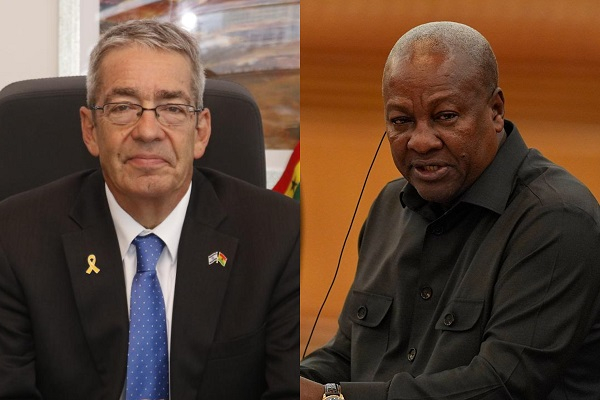
Israel’s Ambassador to Ghana, Roey Gilad, has clarified why his country opposed Ghana’s resolution at the United Nations that led to the declaration of the transatlantic slave trade as the gravest crime against humanity.
Speaking in an interview on JoyNews on April 13, 2026, Ambassador Gilad explained that Israel’s objection was not to the condemnation of slavery itself, but to the specific wording that ranked it above other historical atrocities.
He questioned the idea of assigning comparative weight to tragedies such as the Atlantic slave trade, the Holocaust, the Armenian genocide, and the Rwandan genocide, asking whether it was appropriate to determine which was “gravest.”
According to him, Israel, alongside several other countries—including the United States, the United Kingdom, the European Union, and Armenia—had urged Ghana to revise the wording by removing the phrase “the gravest.” However, those appeals were unsuccessful.
Gilad noted that while there was broad agreement that the slave trade should be recognized as one of the gravest crimes against humanity, establishing a hierarchy among such events was unacceptable to his government.
Meanwhile, John Dramani Mahama has defended the resolution and its wording, maintaining that the scale and brutality of the transatlantic slave trade justify its description as the gravest crime against humanity.
At a recent public engagement, he recounted the horrors endured by enslaved Africans, including instances where enslaved people were treated as cargo and killed for insurance claims. He argued that the magnitude of suffering and loss of life sets the slave trade apart.
Mahama also dismissed arguments that African involvement in the trade diminishes responsibility, drawing parallels with the The Holocaust. He noted that collaboration by some individuals did not negate the overall classification of the Holocaust as a crime against humanity.
Reaffirming his stance, the president stressed that those who designed and financed the slave trade system must be held accountable, insisting that recognizing its gravity is essential to honoring the memory of its victims.
