
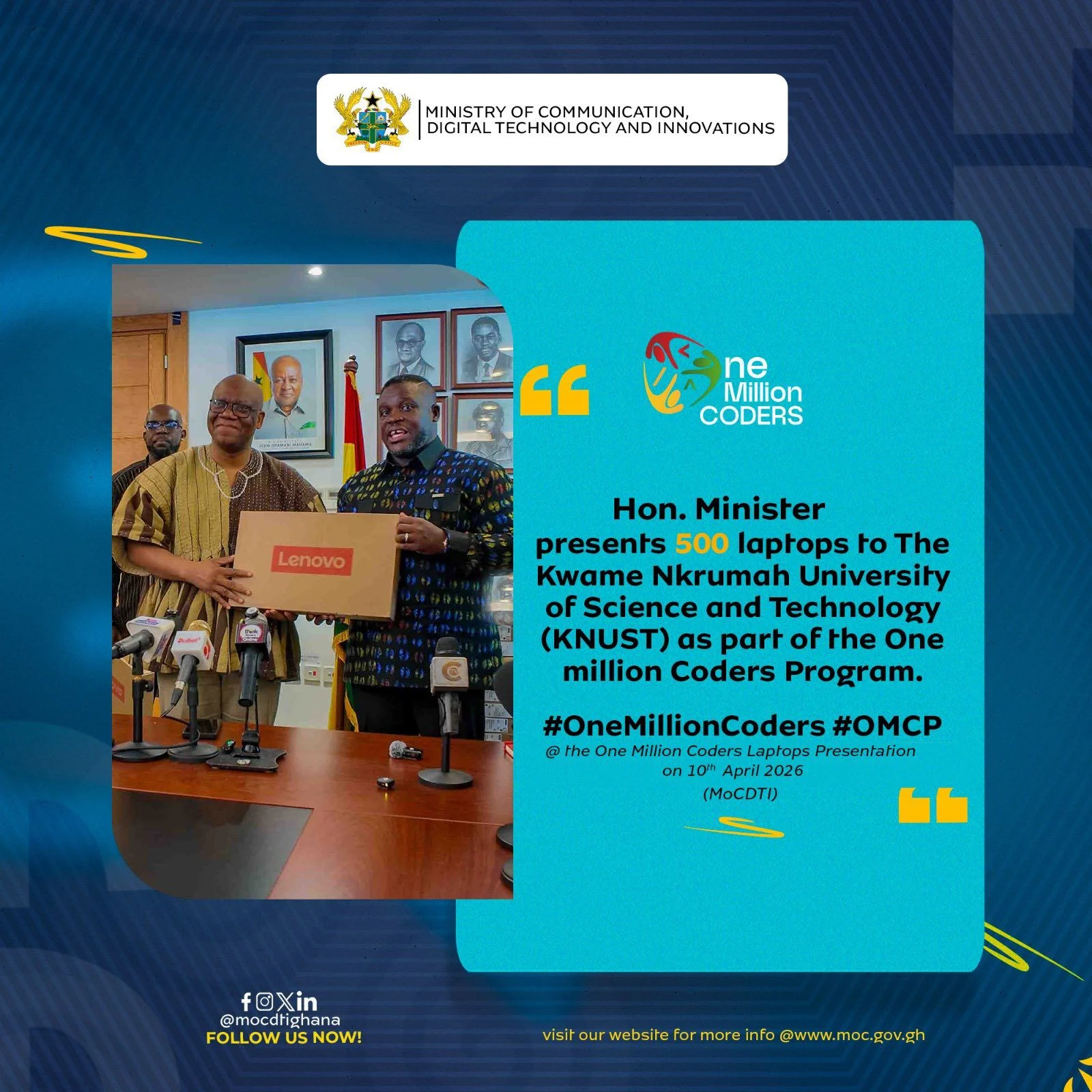
The government has distributed over 8,500 laptops to support the nationwide rollout of its flagship One Million Coders Programme (OMCP), an initiative designed to equip young people within demand digital skills.
The presentation ceremony in Accra marked the start of Phase One, which will see laptops deployed to 130 learning centres across all 16 regions, along with selected universities. The devices will support training in coding, artificial intelligence, and other emerging technologies.
Speaking at the event, Minister for Communication, Digital Technology and Innovations, Samuel Nartey George, said lessons from the pilot phase had informed a stronger and more results-driven national rollout. He stressed that the programme is focused on achieving tangible outcomes rather than meeting symbolic targets.
He explained that each of the 130 centres would receive 50 laptops, totalling about 6,500 devices for community-based training. An additional 2,000 laptops secured through private sector partnerships—will be allocated to universities, with more expected from government sources.
According to the minister, the laptops have been customised to support structured training aligned with the programme’s goals. He noted that the pilot phase, launched nearly a year ago, initially targeted 500 participants across four centres but drew around 94,000 applications within 48 hours. About 1,000 participants were eventually trained, providing valuable insights for scaling up.
To promote inclusivity, the government is working with the Ministry of Gender, Children and Social Protection to reserve 50,000 training slots for persons with disabilities through the Ghana Federation of Disability Organisations, while keeping the programme open to all.
Key implementing agencies include the Ghana Investment Fund for Electronic Communications, Ghana Digital Centres Limited, and the Kofi Annan Centre of Excellence in ICT, alongside university partners.
Beyond training, the initiative aims to drive employment. Mr. George revealed that agreements have been secured with industry players to place up to 200,000 graduates in remote and outsourcing roles.
Each learning centre will also be managed by a technical officer, creating 130 jobs in the first phase. The government plans to track participants’ progress and employment outcomes to ensure accountability and long-term impact.
