

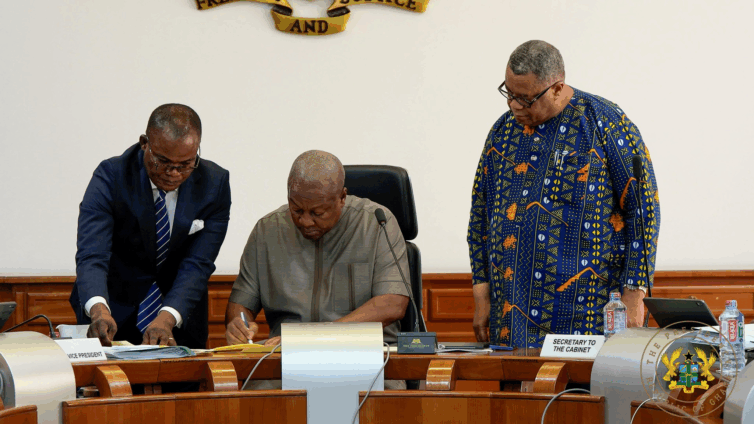
President John Dramani Mahama on Thursday formally passed the 24-Hour Economy Authority Bill, 2025, during a brief ceremony ahead of the 13th cabinet meeting.
Speaking after signing, President Mahama said, “Cabinet colleagues, I just appended my signature to give assent to the 24-Hour Authority Bill. This Bill, which Ghanaians have been waiting for, was one of our flagship strategies for economic transformation.”
He noted that the process had taken time to ensure due diligence, giving the policy initiative full legal effect. “Now we must move from strategy to implementation. The business sector is waiting, Ghanaian investors are waiting, foreign investors are waiting,” he added. “They want to see the package of incentives that we can offer so that they can invest more, expand productivity, and create more employment for our young people. So it’s my pleasure to assent to this Bill today.”
The legislation establishes a 24-Hour Economy Authority, a central body responsible for coordinating and implementing the policy, aligning public and private sector efforts, and addressing infrastructure and regulatory requirements.
Parliament had officially passed the 24-Hour Economy Authority Bill, 2025, a key policy of the Mahama administration, on Friday, February 6, following extensive debates between the Majority and Minority caucuses. The Bill is designed to implement the government’s 24-Hour Economy and Accelerated Export Development Programme.
The government explains that the programme seeks to address longstanding structural challenges in Ghana’s productive sector, reduce reliance on exporting low-value raw materials, and cut dependence on costly imported finished and intermediate goods.
The Authority is expected to drive integrated and sustainable transformation across national systems for economic production, supply chains, marketing, and workforce development. Introduced to Parliament in late 2025, the Bill aims to transition Ghana into a fully operational 24-hour economy, establishing a central body to oversee nationwide implementation, mobilise investment, coordinate public-private activities, and ensure adequate infrastructure and regulatory frameworks for round-the-clock economic activity.
The 24-hour economy initiative was a key campaign promise of the National Democratic Congress (NDC) during the 2024 general elections.
