
The International Monetary Fund (IMF) says the ongoing conflict in the Middle East has significantly disrupted maritime and air transport, affecting key global trade and energy routes.
According to the Fund, the damage to infrastructure and transport corridors means global systems may not fully return to pre-war conditions—even under the most optimistic scenario.
In a recent chart analysis, the IMF highlighted growing concerns in major shipping lanes. It noted that attacks on vessels in the Red Sea since 2023 have forced many ships to reroute around Africa instead of using the Suez Canal.
More than two years later, traffic through the Bab el-Mandeb Strait—between Yemen and Djibouti—remains at about half of pre-attack levels.
The IMF added that uncertainty still surrounds activity in the Strait of Hormuz and regional air travel. However, it warned that economic growth will likely slow even if peace is achieved.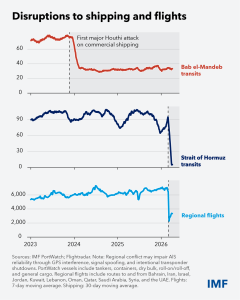
In its April 2026 World Economic Outlook, the Fund explained that disruptions to shipping and aviation increase trade costs, strain supply chains, and hit tourism-dependent and import-reliant economies the hardest.
Consumers are already feeling the impact through higher prices for food and essential goods, with low-income households bearing the greatest burden.
The IMF cautioned that if recovery in key routes like Hormuz mirrors the slow pace seen in Bab el-Mandeb, the economic impact could persist long after the conflict ends.
It stressed that strengthening the resilience of global transport networks is now critical to sustaining growth and protecting livelihoods.
