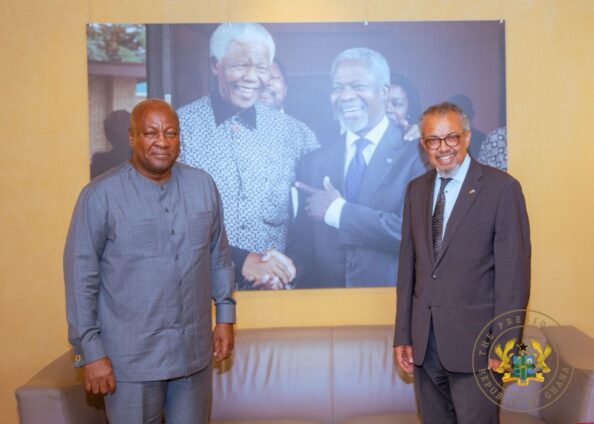
President John Dramani Mahama has outlined several measures introduced by his administration to reduce financial barriers in healthcare delivery across Ghana.
Speaking at the 79th World Health Assembly in Geneva on Monday, May 18, President Mahama said his government has moved beyond rhetoric to implement policies that place citizens at the centre of healthcare delivery.
He said Ghana’s National Health Insurance Scheme remains one of Africa’s more successful health insurance systems, with coverage estimated at 66 percent by the end of 2025.
However, he noted that about 34 percent of the population still lacks insurance coverage.
President Mahama also said the NHIS has focused mainly on curative care, with limited attention given to preventive healthcare.
To address the gap, he announced that the government has started implementing its Free Primary Healthcare Programme.
“By removing financial barriers to the most basic and essential services at the rural level, we have ensured that our citizens in the remotest regions of our country also enjoy access to quality healthcare, on par with their urban counterparts,” he said.
The President thanked the World Health Organization and its Director-General, Tedros Adhanom Ghebreyesus, for supporting Ghana’s healthcare reforms.
He also said the government has revitalised the NHIS by removing the cap on the health insurance fund.
According to him, the decision released an additional GHS3 billion, equivalent to about $300 million, for healthcare investment.
President Mahama said the government has also streamlined NHIS operations through digital reforms and the use of artificial intelligence to detect fraudulent claims.
He added that prompt payments to service providers remain a major priority.
“A health insurance scheme is only as strong as the trust between the state and the hospitals that provide the care. By ensuring our providers are paid on time, we ensure our citizens are treated with dignity,” he stated.
President Mahama further highlighted the launch of the Ghana Medical Trust Fund, also known as MahamaCares, to support people battling non-communicable diseases.
He said the fund supports patients suffering from heart disease, cancer, liver disease, and kidney failure.
“This fund is a lifeline for those suffering from NCDs that were previously a death sentence for the poor,” he said.
The President added that Ghana is also on track to exit funding support from Gavi, the Vaccine Alliance by 2030.
“Ghana is also on track to exit GAVI funding for vaccines by 2030 and hopes to transition into a donor in the not-too-distant future,” he stressed.
He said these achievements form part of the foundation for his leadership of the Accra Reset Initiative.
