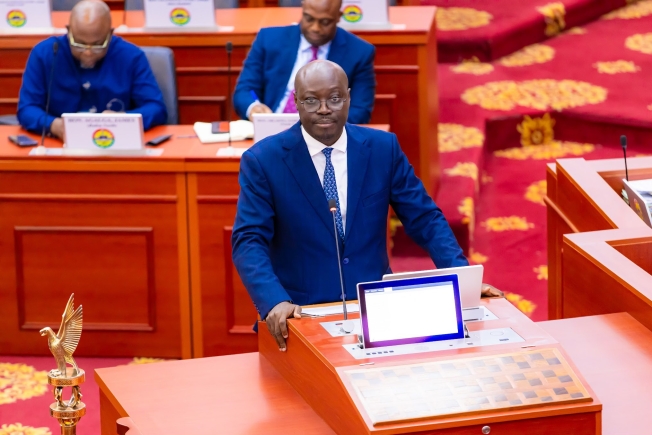
Ghana will no longer seek financial bailout support from the International Monetary Fund, Finance Minister Cassiel Ato Forson has announced, declaring that the country has moved beyond crisis management into a new phase of economic stability and policy-driven growth.
Addressing Parliament on Ghana’s future engagement with the IMF, Dr Forson reflected on the severe economic turmoil that hit the country in 2022, attributing the crisis to reckless spending, excessive borrowing and weak fiscal management.
He said the painful experience served as a critical lesson on the consequences of fiscal indiscipline.
“It is important to recount this not to dwell on the past, but to remind ourselves of the heavy price of fiscal indiscipline and economic recklessness, and to affirm our collective resolve that Ghana must never return to that path,” he stated.
According to the Finance Minister, Ghana has successfully completed the final review of its current IMF-supported programme and will now transition to a non-financing arrangement known as the Policy Coordination Instrument (PCI).
He described the shift as a major achievement under President John Dramani Mahama’s Reset Agenda, saying Ghana’s relationship with the IMF had evolved from dependency to partnership.
“Ghana has evolved from a position of supplicant to one of partner,” Dr Forson said.
He stressed that the new arrangement would focus on policy coordination, reforms and investor confidence rather than direct financial assistance.
“No further IMF financial bailout will be required in the foreseeable future,” he added.
Dr Forson told Parliament that Ghana inherited a deep economic and financial crisis marked by rapid cedi depreciation, soaring inflation, declining investor confidence and loss of access to international capital markets.
He noted that the country’s economic troubles led to repeated sovereign credit rating downgrades and eventually forced Ghana to seek debt treatment under the G20 Common Framework.
He also referenced the Domestic Debt Exchange Programme (DDEP) introduced in December 2022, which imposed significant losses on pensioners, banks and other financial institutions.
“Ordinary Ghanaians bore the heaviest burden of the crisis through runaway inflation, erosion of incomes and savings, high interest rates, job losses and increased economic insecurity,” he stated.
The finance minister said the government recalibrated the IMF-supported programme after taking office, introducing reforms aimed at ensuring fairer burden-sharing and long-term stability.
Among the interventions highlighted were:
- The introduction of a Public Financial Management commitment control system to curb excessive spending
- The operationalisation of the Sinking Fund to manage future debt obligations
- The launch of the GoldBod initiative to strengthen foreign exchange reserves and stabilise the cedi
- The abolition of taxes such as the E-Levy, Betting Tax, Emissions Levy and VAT on motor insurance
- A reduction in the number of ministers from 123 to 60
- The reduction of ministries from 30 to 23 to cut wasteful expenditure
Dr Forson said the reforms had produced strong economic results across several sectors.
According to him:
- Ghana recorded six per cent real GDP growth in 2025, the highest since the pandemic
- Non-oil GDP growth reached 7.6 per cent, the strongest performance in 14 years
- Ghana’s economy surpassed the $100 billion mark in 2025, making it the eighth-largest economy in Africa
- Inflation dropped from 23.8 per cent in December 2024 to 3.4 per cent in April 2026
- Public debt-to-GDP ratio declined from 61.8 per cent in 2024 to 44.7 per cent by the end of 2025
- The cedi appreciated by 40.7 per cent against the US dollar in 2025
- Treasury bill rates and the monetary policy rate also recorded significant declines
“These results affirm a simple but enduring truth: fiscal prudence and discipline always deliver results,” he stated.
Explaining the Policy Coordination Instrument, Dr Forson said the arrangement is designed for countries that no longer need IMF financial assistance but still want policy guidance and reform credibility.
He said the PCI would allow Ghana to continue benefiting from IMF technical support and policy assessments while boosting investor confidence and improving credit ratings.
“In other words, Ghana has moved from the intensive-care unit to the wellness centre,” he said.
Dr Forson also announced plans for a new economic framework called “The New Economy,” expected to be unveiled in the 2027 Budget Statement.
The programme will focus on sustainable job creation, increased productivity, economic resilience and broad-based prosperity.
He thanked Ghanaians for their sacrifices and patience throughout the recovery process and assured citizens that government remained committed to sustaining the gains achieved.
“Our solemn pledge is that we will not be complacent; we will continue the hard work of building the Ghana we want,” he said.
