
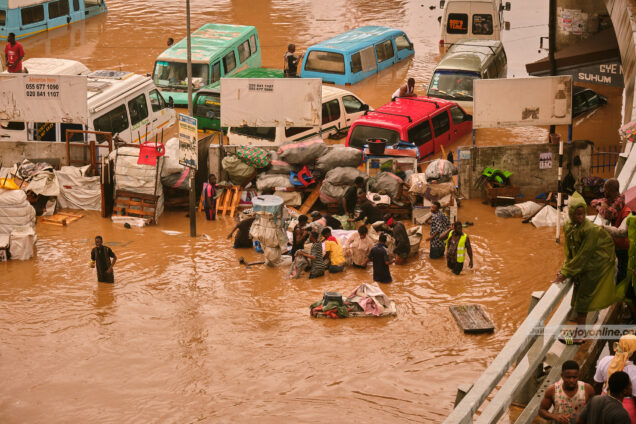
The Ranking Member of Parliament’s Works and Housing Committee, Martin Adjei Mensah Korsah, has rejected Finance Minister Dr Cassiel Ato Forson’s explanation that a court order freezing Ghana’s constitutional contingency fund delayed the government’s response to recent flooding in Accra.
The former Minister for Local Government, Decentralisation and Rural Development described the explanation as surprising and questioned how Cabinet could have approved emergency flood response measures without knowing that the fund was inaccessible.
His remarks follow the presentation of the 2026 Mid-Year Budget Review, during which Dr Forson disclosed that the government could not access the constitutional contingency fund because it had been garnisheed under a court order.
The Finance Minister described the contingency fund as Ghana’s only constitutionally established emergency fund and said its unavailability created major challenges for responding to disasters.
Minority questions Cabinet coordination
Speaking on JoyNews’ The Pulse on Friday, Mr Mensah Korsah said the Finance Minister’s explanation raised serious questions about coordination within government.
“That’s quite a big surprise. The aftermath of the rains and the subsequent overwhelming flooding that we saw, every step that the government took, we in Parliament were made to believe, was as a result of a government emergency response born out of Cabinet deliberations,” he said.
He argued that if Cabinet had approved emergency interventions, ministers—including the Attorney-General—should have been aware that the contingency fund was subject to a garnishee order.
“If the Cabinet of Ghana could convene and brainstorm on measures to mitigate subsequent floods and decided to assess money from the contingency fund and it never occurred to Cabinet… that the contingency fund had a garnishee order, then it’s quite strange. Absolutely strange,” he stated.
According to the Suame MP, the development suggests a possible breakdown in coordination among ministries and state agencies responsible for disaster management.
“This particular claim raises a lot of questions that they either do not work together, they work on their own or that synergy, that working together as a government is not there,” he added.
GARID allegations dismissed
Mr Mensah Korsah also rejected the Finance Minister’s claims that the previous Akufo-Addo administration had mismanaged the Greater Accra Resilient and Integrated Development (GARID) Project.
He described the allegations as “complete falsehoods” and insisted that World Bank implementation reports do not support claims of financial impropriety.
“Again, respectfully, these are heavy untruths, complete falsehoods,” he said.
Citing World Bank implementation reports issued in September 2024 and May 2025, he argued that neither report found evidence of misuse of project funds.
“At nowhere does the World Bank find any wrongdoing or misuse of money. No, you don’t find it anywhere,” he said.
Instead, he maintained that the reports pointed to delays by the Ministry of Finance in releasing funds needed to implement the flood mitigation project.
“Rather, the World Bank believes that in spite of the flooding that is happening all around us, there is a project to deal with it and there’s money which is not being released by the Finance Ministry,” he stated.
Calls for focus on implementation
Mr Mensah Korsah urged the government to prioritise resolving implementation challenges rather than engaging in political exchanges over responsibility for flood management.
He further disclosed that during a recent meeting of Parliament’s Works and Housing Committee involving officials from the Ministries of Finance, Works and Housing, and Sanitation, no allegations of financial misconduct regarding the GARID Project were raised.
According to him, discussions focused on consultant payments and project implementation under the World Bank-funded programme, noting that project components cannot be changed without the lender’s approval.
The exchange between the Minority and the Finance Minister comes amid renewed public scrutiny of Ghana’s flood preparedness following the recent devastating floods in Accra, with growing calls for improved drainage infrastructure, timely release of project funds and stronger coordination among institutions responsible for disaster prevention and emergency response.
