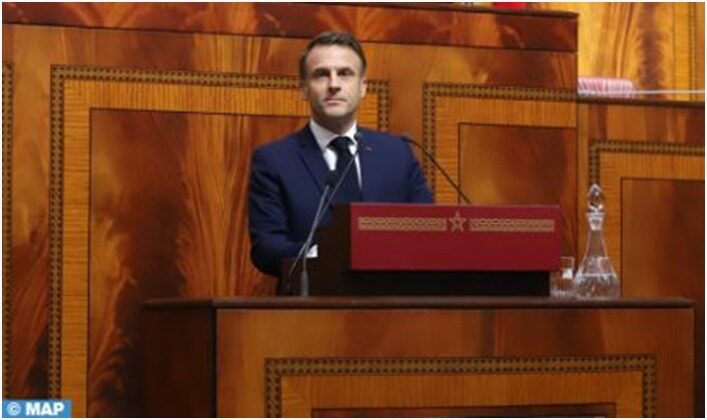
French President Emmanuel Macron has called on major international institutions to support the growing global movement for reparatory justice, describing it as a vital step towards addressing the legacy of the transatlantic slave trade.
Speaking virtually at the Next Steps Conference on Reparatory Justice in Accra, Macron urged organisations such as the United Nations, UNESCO, the African Union and the Caribbean Community to play a more active role in advancing historical accountability and redress.
Call for Global Action
Macron said governments and international bodies must work together to develop a shared approach based on knowledge, dialogue and justice.
“States, regional and international organisations, the United Nations, UNESCO, the African Union, the Caribbean Community, [must work] to build a shared approach founded on knowledge, dialogue and justice,” he said.
The French president also announced France’s intention to collaborate with Ghana and other interested partners on a new international scientific initiative focused on reparatory justice.
“Along with Ghana and other countries or institutions that wish to participate, France would like to launch an international scientific initiative to formulate concrete recommendations and support this movement of recognition,” he added.
France’s Commitment
Macron highlighted several efforts France is undertaking to confront its historical links to slavery and colonialism.
He said these initiatives aim to deepen public understanding of history and promote greater global awareness of the lasting effects of slavery.
The French leader stressed that acknowledging historical injustices is essential to building a more informed and equitable future.
Praise for Ghana’s Leadership
Macron commended Ghana for leading international discussions on reparatory justice and for hosting the conference in Accra.
He praised the country’s efforts to bring together governments, academics, civil society groups and members of the African diaspora to discuss practical pathways towards justice and reconciliation.
The conference comes amid renewed global attention on the legacy of slavery following the adoption of United Nations Resolution A/RES/80/250, which has intensified international debate on reparations and historical accountability.
Convened under the leadership of President John Dramani Mahama, the Accra gathering continues to serve as a key platform for shaping the future of the global reparatory justice agenda.
