

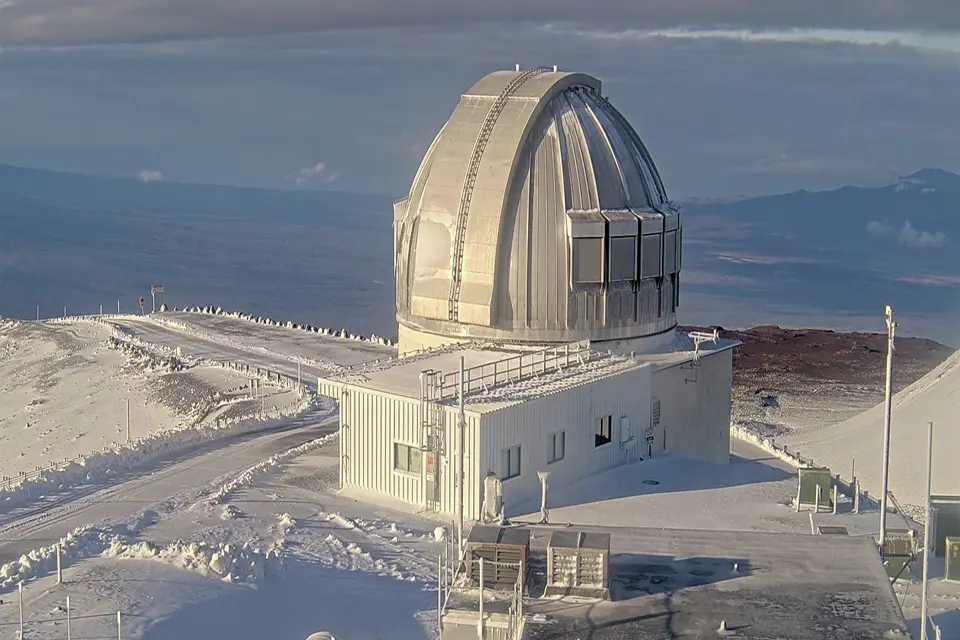
Winter weather arrived on the Hawaiian Islands at the summits of their highest volcanoes.  Snow, ice, and fog have blanketed the peaks of Maunakea and Mauna Loa this week. The snowy conditions were brought on by a storm system that developed over the Islands, known by local forecasters as a “Kona low,” which lowered temperatures and brought several days of rain to the Islands. On Sunday, the National Weather Service issued a winter storm warning for the island of Hawaii’s summits.
“It always snows in Hawaii every winter,” Will Ahue, a meteorologist at the weather service’s Honolulu office, told SFGATE. “The only impact to people is the people who need to go up to the observatories, and they can’t drive and go up there because they can’t see anything,” he said.
Ahue also explained that Maunakea’s and Mauna Loa’s summits are both near 14,000 feet, comparable to mountain peaks in Colorado and California that also receive snow, and that snow is most likely to fall on the summits of Maunakea and Mauna Loa, as they are higher than other Hawaii summits.
On Tuesday, the National Weather Service downgraded the winter storm warning to a winter weather advisory for elevations above 11,000 feet. Meanwhile, the rest of the state has experienced days of heavy rain, particularly across the southeast-to-south-facing mountain slopes on the Big Island and Maui, where persistent winds from the southeast caused the heaviest rains on those sides of the islands.
