

Ohemaa Mercy has explained the biblical meaning behind the striking priestly outfit she wore at the 2026 Tehillah Experience, revealing that the look was deliberately designed to communicate a spiritual message rather than simply make a fashion statement.
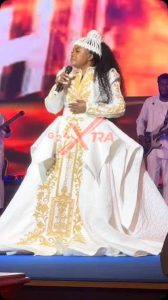
When Ohemaa Mercy stepped onto the stage at this year’s Tehillah Experience, it was difficult to miss her. The gospel musician arrived in an elaborate ceremonial outfit, complete with a distinctive headpiece and a cross carried ahead of her as she made her entrance. The unusual appearance quickly became a talking point among viewers and social media users. But now, Ohemaa Mercy and her management have explained what was behind the carefully planned look. The 13th edition of the Tehillah Experience was held on September 13, 2026, at the Oil Dome of Royalhouse Chapel under the theme “The Altar of Fire.”
Ohemaa Mercy Says It Was More Than a Costume
According to a statement released by her management on September 15, the singer’s entrance was intentionally designed around the theme of the event. Rather than describing it as an ordinary stage entrance, the statement called it an “altar entry.”
Ohemaa Mercy herself also explained that the clothing was intended to communicate a message before she even began singing.
“This was not a fashion statement. It was priesthood.”
That explanation changes the way the outfit can be viewed.
The elaborate design was not presented by her camp as an attempt to create a dramatic fashion moment. Instead, every major element was connected to biblical imagery and the spiritual focus of the programme.
The Headpiece Was Inspired by the High Priest’s Miter
One of the most noticeable parts of Ohemaa Mercy’s outfit was the cap or headpiece. Her management explained that it was inspired by the mitre worn by the High Priest in the Bible, with reference to Exodus 28:36–38. The symbolism was linked to holiness, priesthood, covering, and submission to divine authority. Ohemaa Mercy’s explanation was particularly deliberate because the headpiece could easily have been interpreted simply as an unusual fashion accessory. Instead, she connected it directly to the priestly imagery surrounding the event. For her, the message was about being set apart for service.
Why Was a Cross Carried Ahead of Her?
The cross was another major part of the entrance. According to her management, the cross being carried ahead of Ohemaa Mercy represented the centrality of Christ. The cross was covered with white linen, which the statement associated with righteousness and resurrection, while the position of the cross ahead of the singer was intended to symbolize Christ going before believers. That detail was particularly important to the overall presentation. The procession was not simply designed to introduce the performer to the audience. It was intended to reinforce the religious message of the entire event.
The Colors Also Had a Meaning
The flowing garment came with its own symbolism. Her management explained that white represented purity and consecration, while gold represented glory and kingship. The crimson color was associated with sacrifice. Together, the colors were presented as part of the larger message surrounding the theme “The Altar of Fire.”The entrance was also accompanied by horns and intercessory prayers, further reinforcing the intended biblical and ceremonial character of the moment.
From Concert Entrance to Spiritual Message
The explanation has now given fans more context about one of the most talked-about moments from the 2026 Tehillah Experience. Rather than leaving viewers to interpret the unusual outfit on their own, Ohemaa Mercy’s team has laid out the symbolism behind the headpiece, cross, colours and procession. The event itself brought together thousands of gospel music lovers, with performances from artistes including Francis Amo, Ceccy Twum, SK Frimpong, Michael Mahendere, Petra Odubayo and Kofi Peprah. But it was Ohemaa Mercy’s entrance that became one of the defining visual moments of the programme. Her management ultimately described the entire presentation as “Priestly Regalia for an Altar Assignment.”
Whether every viewer interprets the symbolism in exactly the same way is another matter, but Ohemaa Mercy has now made her own intention clear: the outfit was designed to tell a biblical story before the music even began.
After seeing the explanation, do you think Ohemaa Mercy’s Tehillah outfit successfully communicated the spiritual message she intended?
