
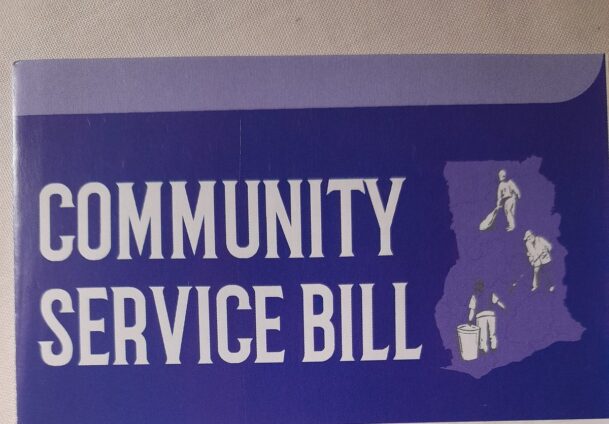
Parliament has passed the Community Service Bill, 2026, introducing community service as an alternative to imprisonment for people convicted of specified categories of offences.
The new law establishes a National Community Service Secretariat and provides the legal framework for implementing non-custodial sentencing. The measure aims to reduce overcrowding in Ghana’s prisons while promoting the rehabilitation and reintegration of offenders.
The Minister for the Interior, Mohammed-Mubarak Muntaka, presented the Bill to Parliament on March 4, 2026, in accordance with Article 106(1) of the 1992 Constitution. Parliament later referred it to the Defence and Interior Committee for scrutiny before approving it.
Law targets prison overcrowding
The committee’s report said Ghana’s criminal justice system has relied heavily on custodial sentences over the years. It noted that this approach has contributed to persistent overcrowding in correctional facilities.
According to the report, overcrowding has placed enormous pressure on the Ghana Prisons Service and increased government spending on inmate feeding, healthcare, maintenance and prison infrastructure.
The committee said the legislation forms part of broader criminal justice reforms being implemented by the Ministry of the Interior to expand the use of non-custodial sentencing.
Courts gain wider sentencing options
Under the new law, courts will have broader discretion to impose community service instead of prison terms for eligible offenders and specified offences.
The legislation seeks to provide additional sentencing options for minor offences while encouraging rehabilitation, reducing repeat offending and supporting the successful reintegration of offenders into society.
The committee also noted that Ghana’s efforts to establish a structured non-custodial sentencing system date back to 2014, when the Ministry of the Interior, with support from UNICEF, began developing a national non-custodial sentencing policy.
Bill strengthens existing legal framework
The Community Service Bill gives legal backing to existing non-custodial sentencing provisions contained in the Criminal and Other Offences (Procedure) Act, 1960 (Act 30), and the Interpretation Act, 2009 (Act 792).
Parliament’s Defence and Interior Committee said the legislation will strengthen Ghana’s criminal justice system, improve the management of correctional facilities and ensure that custodial sentences are reserved for cases where imprisonment is necessary.
