
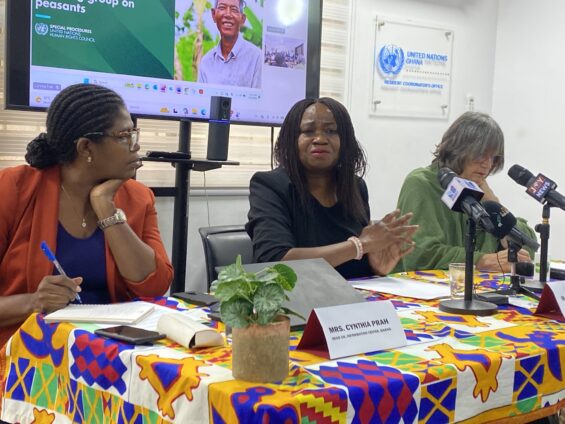
A United Nations working group has warned that Ghana could face food shortages, social unrest, and growing insecurity if the country fails to support sustainable agriculture and rural livelihoods.
Uche Ofodile said neglecting rural communities and sustainable farming could have serious long-term consequences for the country.
“If there is a problem with food availability, especially during crises and international instability, there will be unrest,” she said.
The warning was issued on Thursday during an end-of-mission press briefing in Accra after a 10-day visit to Ghana by the United Nations Human Rights Council Working Group on the Rights of Peasants and Other People Working in Rural Areas.
During the visit, the group met government officials, farmers, fisherfolk, pastoralists, civil society groups, traditional leaders, and rural communities.
Prof. Ofodile said the issue goes beyond food supply. She noted that it also affects nutrition, national security, youth unemployment, and economic stability.
She warned that many African countries remain heavily dependent on imported fertilisers and other agricultural inputs, making them vulnerable during global crises.
The group also raised concern about growing youth unemployment in rural areas. According to Prof. Ofodile, many young people are leaving farming for illegal mining because agriculture no longer provides stable incomes.
She added that young women in rural communities also face increasing economic hardship and teenage pregnancy.
The experts said Ghana has made progress through policies on climate resilience, fisheries reforms, gender equity, and social protection. However, they noted that many smallholder farmers, artisanal fishers, and pastoralists are still excluded from major decisions affecting their livelihoods.
The group warned that Ghana’s push for mechanised and export-driven agriculture could sideline smallholder farmers, who remain central to the country’s food production system.
The experts identified climate change and illegal mining, known locally as galamsey, as major threats to rural communities.
They described galamsey as one of Ghana’s most serious environmental crises, citing polluted rivers, destroyed farmland, and the spread of toxic chemicals such as mercury.
According to the group, illegal mining is not only an environmental problem but also a sign of deeper economic struggles facing rural youth.
The delegation also expressed concern about land insecurity, especially for women, young people, pastoralists, and smallholder farmers.
It noted that many women remain excluded from land ownership and decision-making despite their major role in farming and fisheries.
The group further highlighted the vulnerability of older women accused of witchcraft, saying such accusations often lead to displacement and loss of livelihoods.
The experts commended Ghana for strengthening its human rights framework through laws such as the Fisheries and Aquaculture Act 2025, the Social Protection Act 2025, and the Affirmative Action (Gender Equity) Act 2024.
They also praised programmes like the Community Resource Management Area model and the National Alternative Employment and Livelihood Programme.
However, the group stressed that lasting progress would require stronger political commitment, deeper community involvement, and sustained investment in rural development.
Prof. Ofodile urged the media to amplify the concerns of peasant farmers and support efforts to protect rural livelihoods.
The UN working group monitors the implementation of the UN Declaration on the Rights of Peasants, which seeks to protect small-scale farmers, fisherfolk, and pastoralists from inequality and land-related abuses.
The group was established in 2024 and carried out its first official visit to Ghana from May 5 to 14, 2026.
A full report on its findings and recommendations will be presented to the UN Human Rights Council in September 2026.
