

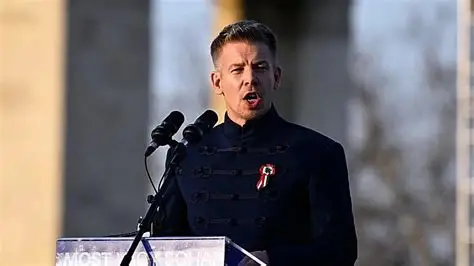
Péter Magyar has rapidly become one of the most talked-about political figures in Europe after securing a historic victory in Hungary’s 2026 parliamentary elections. His party, Tisza, won a two-thirds majority in parliament, ending the 16-year rule of Viktor Orbán.
This landslide win marks a major political shift not just for Hungary, but for Europe as a whole. For many voters, the election represented a clear desire for change after years of centralized power and political tension.
Interestingly, Magyar was not always an outsider. He was once closely associated with Orbán’s ruling party, Fidesz, and even held roles within the government.
However, in 2024, he broke ranks following growing dissatisfaction with how the country was being governed. A major turning point came during a political scandal that exposed deep concerns about corruption and accountability within the system.
His decision to speak out transformed him from a government insider into a powerful opposition voice almost overnight.
After leaving the establishment, Magyar took leadership of the relatively unknown Tisza Party and turned it into a national force. Within a short period, the party gained massive support, especially among young voters and those frustrated with the status quo.
His message focused on anti-corruption, transparency, and restoring democratic institutions. This resonated strongly with Hungarians facing economic challenges and political fatigue.
By the time of the 2026 elections, Tisza had become a serious contender, and ultimately, the dominant political force in the country.
Magyar is widely seen as a pro-European leader who wants to realign Hungary with the European Union and strengthen ties with Western allies. He has pledged to restore democratic norms, improve governance, and unlock billions in frozen EU funds.
His victory has been welcomed by many European leaders, who see it as a chance for Hungary to return to the political mainstream after years of tension with EU institutions.
Following his victory, Magyar has outlined an ambitious reform agenda. His priorities include fighting corruption and increasing transparency, reforming the constitution and limiting political power, strengthening the rule of law and reviving Hungary’s economy and public services
With a strong parliamentary majority, he has the power to implement significant changes, something that could reshape Hungary’s political system for years to come.
Despite the optimism, Magyar faces major challenges. Hungary’s institutions have been shaped by years of Fidesz rule, meaning reforms may not be straightforward.
There are also economic pressures and geopolitical considerations, especially regarding relations with the EU, NATO, and Russia.
Additionally, critics point out that while his message is powerful, some of his policies remain broad and will need clearer definition as he transitions from campaigner to leader.
Péter Magyar’s rise represents a rare political transformation. From insider to reformist leader, his journey reflects the changing mood of Hungarian voters.
His victory signals a potential turning point, not just for Hungary, but for European politics more broadly. Whether he can deliver on his promises remains to be seen, but one thing is clear: Hungary has entered a new political era.
