
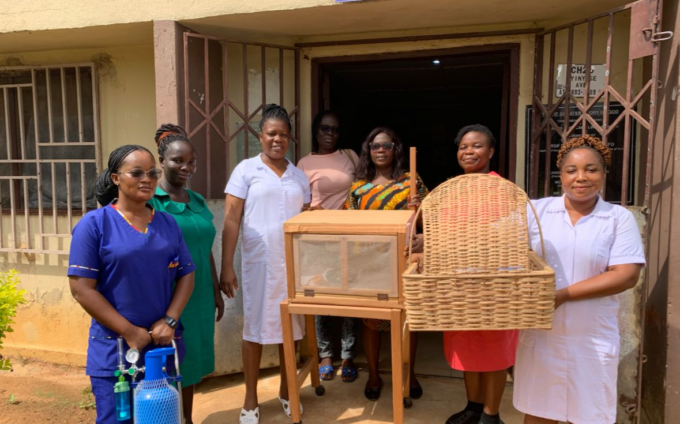
In the rural communities of Apinkra, Behenase, Nuaso and Kokrobikro in the Bosomtwe District, accessing advanced medical care is often as difficult as the emergencies that require it. Poor road conditions turn every referral into a risky and exhausting journey for both caregivers and newborns.
At St. Mary’s Anglican Clinic, where many residents rely on maternal and newborn services, these challenges have long been a daily reality.
When Margaret Ako Tsakle was posted to the facility in 2016, she worked as the sole midwife handling deliveries, complications, and emergency referrals, sometimes while caring for her own infant.
But the most difficult moments came during transfers.
With only one ambulance serving the district, midwives often had to rely on taxis when emergencies arose. Newborns in distress were placed on laps, while essential medical items were carried separately often disorganised and sometimes forgotten in the urgency of the moment.
On rough roads, the situation became even more precarious. Providing care such as suctioning, changing diapers, or administering oxygen was nearly impossible while holding a fragile baby in a moving vehicle.
Faced with these challenges, Margaret began developing a practical solution in 2019 one shaped directly by her experience on those journeys.
The result is the “Emergency Traveling Basket.”
Handmade and rectangular, the basket is designed to securely hold a newborn during transport while keeping essential medical supplies organised and within reach. It provides a stable space for the baby, reducing movement during bumpy rides, and includes features such as a provision to hang intravenous fluids, a cord clamp for emergencies, and a thermometer for monitoring temperature.
It also accommodates referral notes, maternal records, diapers, clothing, and other essentials items that were previously difficult to manage during hurried transfers. For longer journeys, especially at night, a mosquito net can be attached for added protection.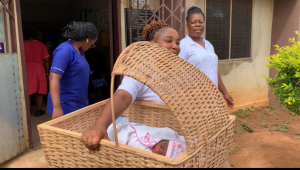
For staff at the clinic, the impact has been immediate. The basket has reduced the burden on midwives, who previously had to manage both mother and baby under difficult conditions, sometimes without assistance.
With support from her supervisors, Margaret is now seeking to scale the innovation.
She hopes to produce at least 100 baskets for distribution across rural health facilities, where similar challenges persist. “If we get that, a lot of rural facilities can benefit,” she said.
While the basket does not replace ambulances or fix poor road networks, it offers a practical, low-cost solution that improves safety and care during emergency newborn transfers—turning a chaotic journey into a more controlled one.
