
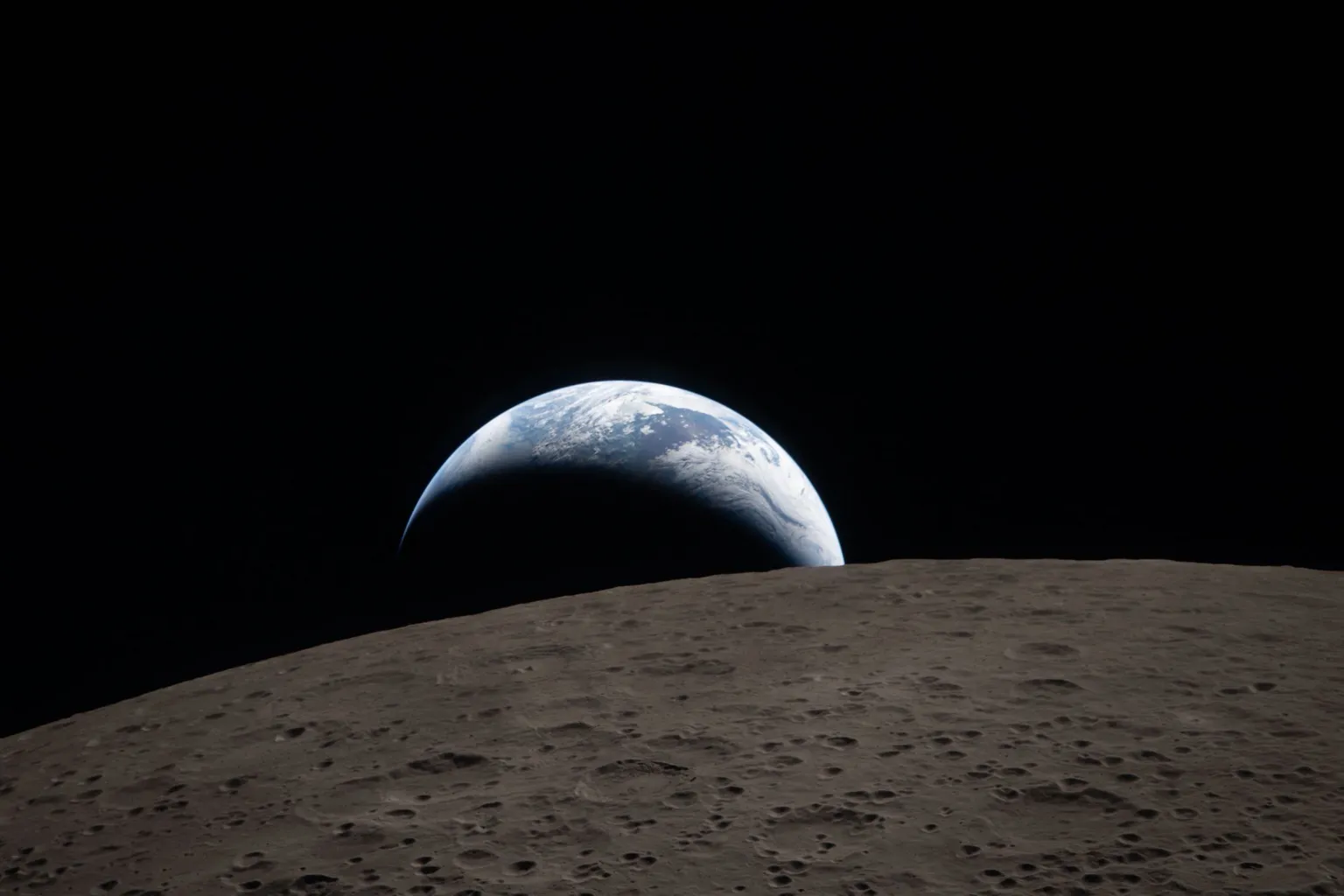
NASA has released the first stunning images captured by astronauts aboard Artemis II during their historic flyby of the Moon.
One of the standout photographs shows a breathtaking “Earthset,” with our planet appearing to sink behind the Moon’s rugged, cratered horizon. Another remarkable image captures a rare solar eclipse, as the Moon completely blocks the Sun, revealing its glowing corona.
NASA did not specify which of the crew members took the images as they continue their journey back to Earth.
The Earthset photo draws powerful comparisons to the iconic “Earthrise” image taken by William Anders during the Apollo 8 mission in 1968. That photograph, showing Earth suspended in the vast darkness of space, remains one of the most influential environmental images ever captured.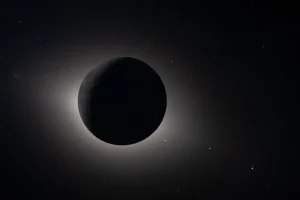
The Artemis II crew took their photographs during a six-hour flyby of the Moon, including a period of radio silence while their spacecraft, Orion spacecraft, passed behind the lunar far side.
According to NASA, the Earthset image was taken through Orion’s window at 18:41 Eastern Daylight Time on Monday. In the image, the night side of Earth is visible, while swirling clouds stretch across the sunlit regions over Australia and Oceania. In the foreground lies Ohm crater, notable for its terraced edges and central peaks—features formed when the Moon’s surface briefly liquefied during a powerful impact.
For the astronauts, one of the most unforgettable moments was witnessing a solar eclipse from space. Unlike the brief eclipses seen from Earth, the crew experienced nearly 54 minutes of totality due to their position near the Moon. The Sun’s corona formed a brilliant halo around the lunar silhouette, while the planet Venus appeared as a bright point of light nearby.
Astronaut Victor Glover described the experience as “unreal” and “sci-fi,” marveling at the glowing corona and the striking contrast between the illuminated Earth and the shadowed Moon.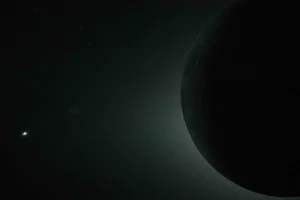
Although robotic missions have photographed the Moon’s far side for decades, NASA emphasized that direct human observation offers unique scientific value. The crew recorded detailed audio notes during the flyby, which scientists will now analyze for new insights.
As the spacecraft emerged from behind the Moon, the astronauts captured another iconic moment Earthrise marking the return of our planet into view after their journey through lunar shadow.
