
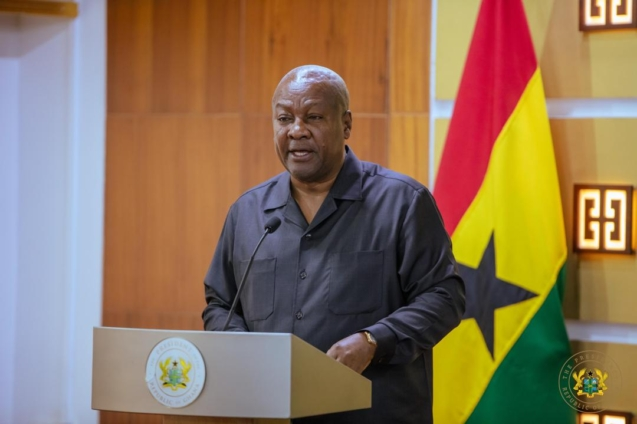
President John Dramani Mahama has called on African leaders to urgently focus on skills development, regional cooperation, and domestic production, warning that the continent risks falling behind in a quickly changing global economy.
Addressing the Accra Reset Davos Convening on Thursday, January 22, President Mahama cautioned that Africa must innovate and build competitive economies or face growing frustration from its youthful population, which is increasingly demanding jobs and opportunities.
He identified skills development as the most critical starting point, stressing that education must be closely aligned with the real needs of modern economies.
According to him, governments should move beyond traditional academic pathways and invest heavily in digital skills, green energy expertise, and manufacturing capabilities that empower young people to become producers and builders of economic value.
President Mahama also emphasized the importance of regional integration, arguing that industrialization cannot be achieved by individual countries acting alone.
He called for stronger collaboration through regional manufacturing hubs, shared power infrastructure, and integrated digital systems to help African businesses scale up and enable workers to access opportunities across borders.
On Africa’s relationship with the global economy, he urged leaders to adopt a united front when negotiating on strategic issues such as minerals, trade, and climate finance.
He noted that disjointed negotiations weaken the continent’s influence, while collective engagement would significantly enhance Africa’s bargaining power.
The President further highlighted the urgency of boosting domestic production, insisting that Africa must manufacture essential goods, including vaccines, semiconductors, and solar panels, to reduce dependence on external suppliers and build economic resilience. He rejected the notion that industrial policy is outdated, describing it instead as a necessity for survival.
“If we do not produce what we need – from vaccines to semiconductors to solar panels – we will remain dependent on those who do,” he said. “Industrial policy is not old-fashioned. It is essential to our survival. We must hold ourselves accountable to our people.”
President Mahama also linked Africa’s reform agenda to governance, warning that corruption, inefficiency, and weak institutions undermine credibility and investor confidence.
“We cannot expect the world to invest in us if we tolerate corruption, waste, and systems that do not work. Reset means reform, and reform must deliver results,” he added.
