

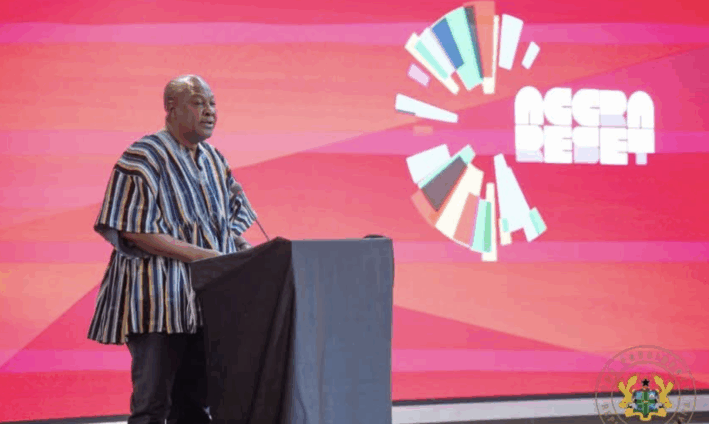
President John Mahama has announced reforms aimed at enabling Ghana to purchase cocoa in Cedis and to halt the export of raw mineral ores by 2030, marking a shift toward economic sovereignty. A statement issued by Ghana’s Presidency said the President announced the closing of his high-level side event, “Accra Reset’s Addis Reckoning,” held on the sidelines of the 39th African Union Assembly of Heads of State and Government in Addis Ababa, Ethiopia.
To put an end to what he called exploitative financing arrangements that have long limited Ghana’s cocoa industry, President Mahama laid forth urgent measures. “One of the key decisions we’ve made is to stop accepting foreign funding for the purchase of our cocoa. We will raise domestic bonds. We have enough Cedis in Ghana to pay for our cocoa,” he said.
He claimed that fundamental flaws had been shown by Ghana’s cocoa crisis. Subsequent market fluctuations resulted in losses when prices dropped to $4,200 per tonne, and the cedi rose to 10.7 per dollar, following the setting of a producer price when international cocoa was trading at $7,200 per tonne, and the Ghanaian cedi was at 11.5 to the dollar. President Mahama explained that under existing foreign financing arrangements, cocoa beans are used as collateral.
“You know what the collateral for the funding is? Our own cocoa beans. You collateralise the beans with the financier, buy them, ship them, and they pay you the international market price,” he said. He noted that although Ghana has the capacity to process 400,000 tonnes of cocoa locally, the collateralisation arrangement prevents allocation of beans to domestic processors. “We must ship all the beans outside,” he added.
In order to buy cocoa directly from farmers, Ghana would issue domestic bonds in Cedis under the new plan. This will remove the need to pledge beans as collateral and release 400,000 tonnes of cocoa for local processing, which might lead to the creation of thousands of jobs and maintain more value in the economy. “I say by 2030, there won’t be any raw mineral ores leaving Ghana. You’re not going to ship raw manganese ore out of Ghana. You’re not going to ship raw bauxite ore out of Ghana. You’re not going to ship raw iron ore out of Ghana. You must process all that locally,” he stated.
According to him, the actions are a component of the larger Accra Reset concept, a continental endeavour that aims to increase development by reclaiming control over natural resources and boosting indigenous manufacturing. President Mahama attributed the measures to the growing aspirations of Africa’s young. “That is the only way we can provide opportunities for our young people. Our young people are less patient than our generation. They want to see that progress and prosperity today,” he said.
He connected the urgency to migration pressures, stating that implementation was necessary to stop young Africans from “braving the dangers of the Sahara and the Mediterranean” in search of opportunity. Emphasising the need for swift action, he endorsed moving ahead with willing partners if consensus delays progress. “We come with the decisions. We agree. We do the frameworks. What is missing is urgency and implementation. We take time. And we behave like time is waiting for us,” he said. “That is why Accra Reset is a good idea. But let’s implement urgently. If parts of the continent are not ready, let’s form a coalition of the willing to move this as quickly as possible. And let all the others follow and join.”
The announcements in Addis Ababa signal Ghana’s intention to lead by example with concrete measures that other African nations may replicate.
“From Addis, we must stop talking and start implementing,” President Mahama concluded, describing the gathering as “the Addis reckoning.”
